
For years, the conversation around crypto adoption in Africa has been framed as a matter of “when, not if.” But for merchants, the retailers, e-commerce operators, and small business owners at the coal face of everyday commerce, the reality has been far more hesitant. Regulatory fog, settlement risks, and customer unfamiliarity kept most of them on the sidelines.
That’s changing. And if the data and the people building this infrastructure are to be believed, 2026 is the year the tipping point finally arrives.
Sub-Saharan Africa Is Already the World’s Third Fastest Growing Crypto Market
Before diving into what’s coming, it’s worth appreciating how far things have already moved. According to Chainalysis, a leading blockchain data platform, sub-Saharan Africa recorded a staggering 52% year-on-year growth in on-chain crypto activity between July 2024 and June 2025. Total on-chain value for the region exceeded $205 billion over that period, placing it third globally in terms of growth rate.
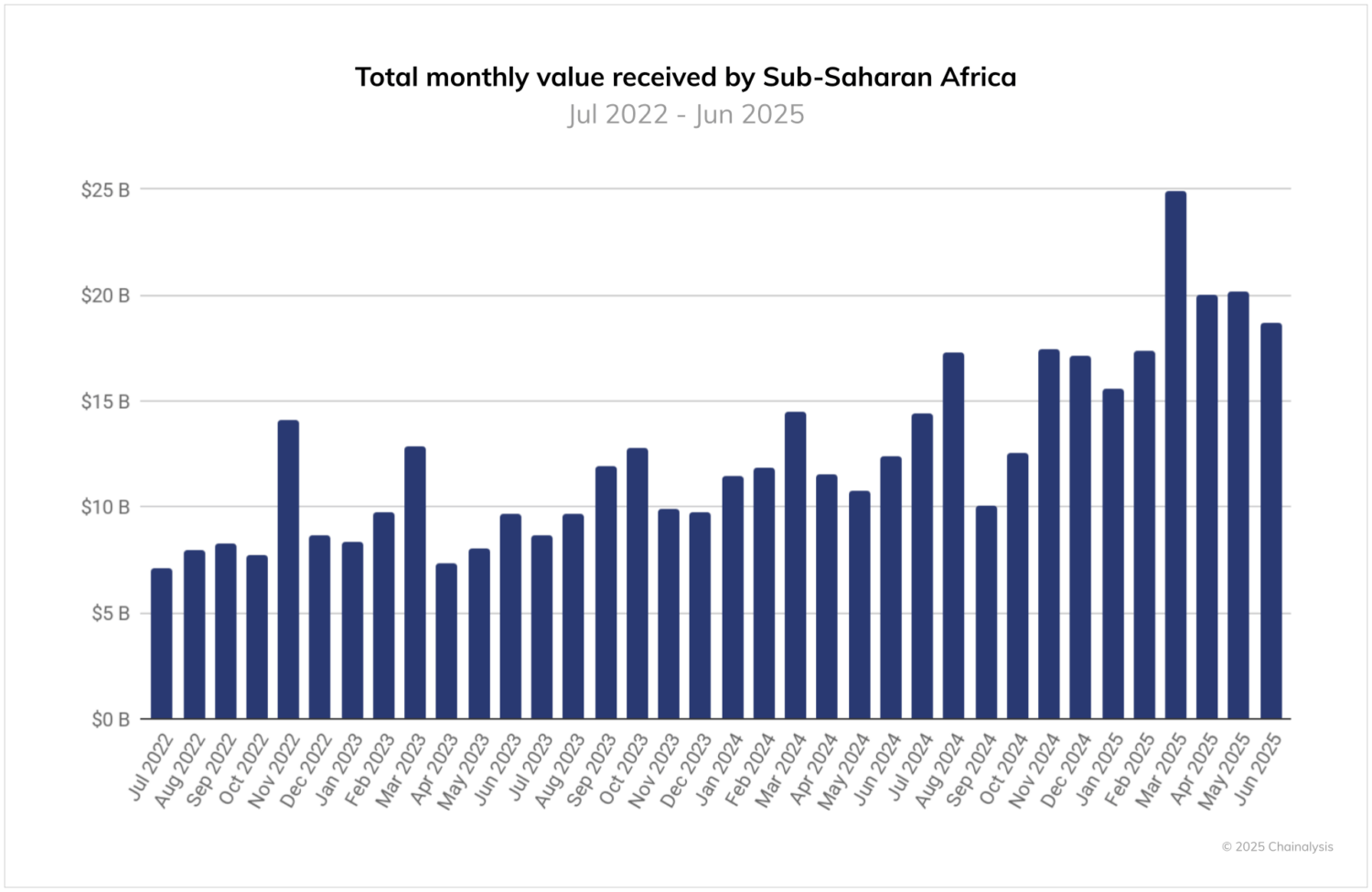
South Africa alone contributed an estimated $35 billion to $40 billion of that figure. Stablecoins now account for more than 45% of all crypto volume in the region, a number that tells you something important: this isn’t speculative mania. People are using crypto as a practical financial tool.
“The Inflection Point Is Not Years Away, It’s Here”

Daniel Katz, co-founder and CEO of Ezeebit, a merchant payment infrastructure company helping retailers accept crypto and stablecoins while settling in fiat, doesn’t mince words.
“Adoption will hit hard this year, and the curve will be exponential rather than gradual,” Katz says. “The lag between regulation being written and its impact being felt is finally closing. Banks and payments players are actively building tokenisation and stablecoin projects, and rand-backed stablecoins are beginning to reach ordinary users.”
For context, Ezeebit’s model allows merchants to accept payments from any crypto wallet and receive settlement in local currency, removing the volatility risk that has long been the most-cited barrier to merchant adoption.
Christo de Wit, country manager for South Africa at Luno, offers a similar diagnosis, though with a more measured cadence. “We’ve seen growing use cases beyond trading, including cross-border transfers, hedging against currency volatility, and treasury diversification, which signal a shift from experimentation towards practical utility.”
He describes adoption as entering “a more mature phase,” though expects it will happen in waves rather than overnight.
Why Stablecoins Are the Real Story
When most people think of crypto, they think of Bitcoin’s dramatic price swings or Ethereum’s developer ecosystem. But the merchant adoption narrative in Africa runs on stablecoins, dollar-denominated digital assets that combine blockchain efficiency with price predictability.
“Stablecoins combine many of the benefits of blockchain technology, faster settlement, lower transaction costs, with price stability,” de Wit explains. “That makes them far more suitable for payments and business transactions than volatile crypto assets.”
In a region where cross-border trade is hampered by expensive forex channels, slow correspondent banking, and currency risk, stablecoins offer a genuinely compelling alternative. They don’t require a merchant to speculate on crypto prices. They just need to work, and increasingly, they do.
Rand-backed stablecoins, in particular, represent an interesting development for the local market. These instruments give South African merchants the efficiency of blockchain rails without exposure to USD/ZAR fluctuations, opening the door for a much broader set of business use cases.
The Regulatory Fog Is Lifting
One of the most significant shifts underpinning the 2026 narrative is regulatory clarity. South Africa has been quietly but steadily building one of the continent’s most structured crypto frameworks.
Here’s how it came together: In October 2022, the Financial Sector Conduct Authority (FSCA) declared crypto assets “financial products” under the Financial Advisory and Intermediary Services (FAIS) Act. That was the critical legal foundation. The CASP (Crypto Asset Service Provider) licensing regime then launched in June 2023, and by early 2026, approximately 300 licences had been approved from 512 applications, creating a credible, regulated ecosystem for businesses to operate within.
April 2025 marked another milestone: the Financial Intelligence Centre implemented the Travel Rule for crypto transfers, bringing South Africa in line with international anti-money laundering and counter-terrorism financing standards.
Beyond South Africa, Kenya’s VASP Act, enforced in late 2025, brought fintech and online monetary services including crypto under formal regulatory oversight. Nigeria, for its part, continues to build out SEC oversight frameworks for the sector.
“In many jurisdictions, including South Africa, regulators are increasingly focused on integrating crypto into existing financial frameworks rather than treating it as an entirely separate system,” de Wit says. “Greater clarity increases trust, attracts institutional participation and encourages responsible innovation.”
What’s Still Holding Merchants Back
Despite the tailwinds, hesitancy among merchants hasn’t completely evaporated. The concerns are real, even if many are solvable.
Katz maps them out plainly: “They worry about price volatility between payment and settlement, are unsure who carries that risk, and fear messy reconciliation if funds don’t arrive predictably in local currency. Regulation and compliance add to the anxiety, because even as rules mature, business owners are unclear whether they or the provider sit in the regulators’ sights.”
Then there’s the perception problem. Crypto still carries an aura of technical complexity, something for developers and traders, not shopkeepers and logistics managers. Many merchants assume their customers simply don’t want to pay with crypto, so there’s little incentive to build the capability.
That assumption, Katz suggests, may be less accurate than it seems. The demand is there , it’s the infrastructure and the confidence that has been missing.
The Merchant Experience Is Simpler Than You’d Think
Here’s the part that tends to surprise people when they first hear it: from a merchant’s perspective, accepting crypto payments through a well-designed system looks almost identical to accepting a card or QR code payment.
“The transaction experience is identical to card or QR payments from the merchant’s perspective,” de Wit says. “There’s no volatility exposure, no technical burden, and settlement happens in rands through normal banking channels.”
Major retailers have already tested this. Pick n Pay, one of South Africa’s largest supermarket chains, has integrated crypto payments, and the experience, by all accounts, has been simpler than anticipated while opening up access to a new customer segment.
For smaller merchants, the lesson is the same: the barriers are lower than the fear suggests, and the upside, particularly for businesses involved in cross-border trade, remittances, or digital goods, can be substantial.
What Should Merchants Do Right Now?
For businesses considering their first steps into crypto payment acceptance, Katz recommends prioritising solutions that handle compliance and crypto complexity behind the scenes. The goal is omnichannel, direct-to-merchant integration that doesn’t require the merchant to understand blockchain mechanics.
Think of it like accepting card payments in the early 2000s: few retailers understood the plumbing of payment networks. They just needed a reliable terminal and funds in their account at the end of the day. That’s where well-designed crypto infrastructure is heading.
De Wit expects the broader adoption arc to follow a familiar financial technology pattern: early movers test use cases, infrastructure matures, and broader participation follows once the benefits clearly outweigh the friction.