
The cryptocurrency payments landscape is experiencing a seismic shift. According to a comprehensive report by Artemis Analytics, crypto card payments have emerged as the fastest-growing segment in digital payments, now rivaling traditional peer-to-peer (P2P) stablecoin transfers in total volume. This transformation signals a fundamental change in how people interact with digital assets in their daily lives.
The Numbers Tell a Compelling Story
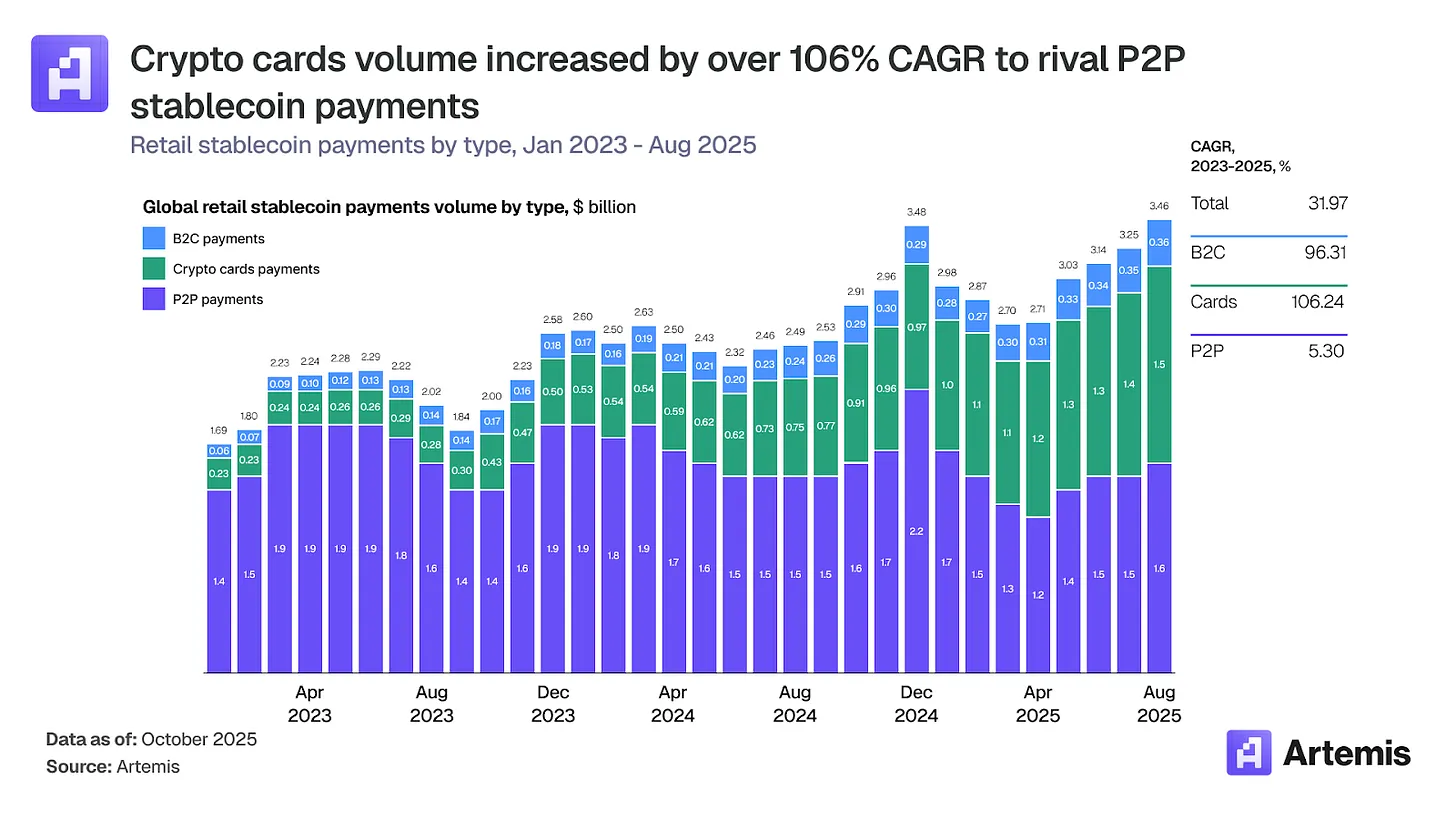
The data from Artemis reveals remarkable growth metrics that few industry observers predicted. Crypto card volumes have experienced a compound annual growth rate of 106% since January 2023, catapulting from approximately $100 million in monthly transactions to over $1.5 billion by late 2025. When annualized, the market now exceeds $18 billion, nearly matching P2P stablecoin transfers which stand at $19 billion with a modest 5% growth rate over the same period.
This explosive growth represents more than just numbers on a spreadsheet. It demonstrates a fundamental shift in consumer behavior, where cryptocurrency holders are increasingly seeking seamless ways to spend their digital assets in the real world without the friction of constant conversions.
Understanding Crypto Card Infrastructure
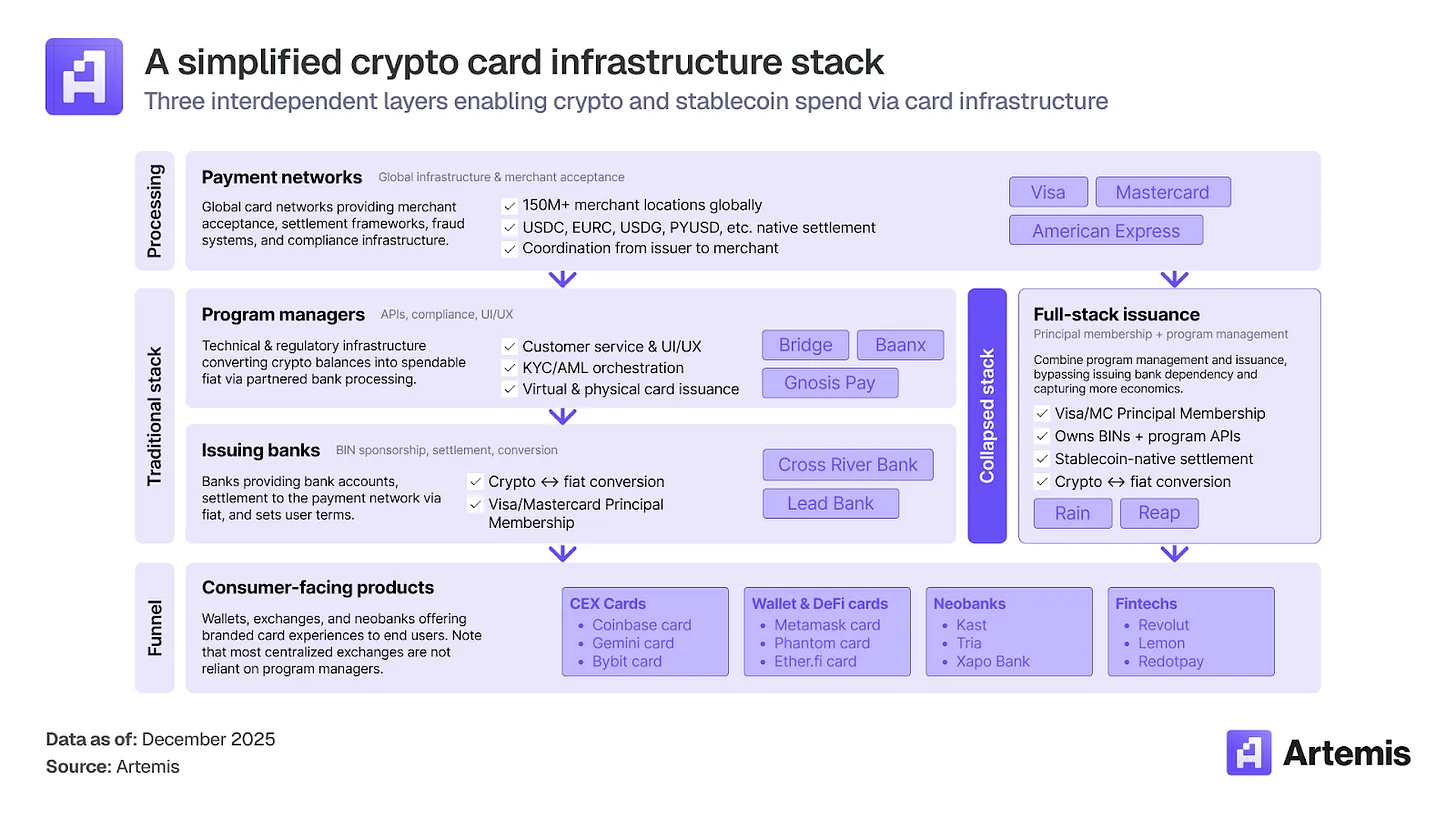
Crypto cards bridge the gap between digital asset holdings and traditional merchant networks. When users swipe their crypto card at any merchant location, the transaction flows through a sophisticated three-layer infrastructure stack that makes spending cryptocurrency as simple as using a traditional debit or credit card.
The Three-Layer Stack
Layer 1: Payment Networks
Visa and Mastercard dominate the crypto card space with nearly 100% market share. Despite similar program counts (130+ each), Visa captures over 90% of on-chain card volume through strategic early partnerships with infrastructure providers. The networks approach of partnering with emerging program managers has proven more scalable than direct exchange partnerships.
Layer 2: Card Issuing Infrastructure
This layer has evolved significantly with the emergence of full-stack issuers like Rain and Reap. These companies hold direct principal membership with payment networks, combining program management with issuance capabilities. By eliminating traditional banking intermediaries, they capture more value per transaction and offer faster settlement times.
Layer 3: Consumer-Facing Products
From centralized exchange cards (Coinbase, Bybit, Gemini) to self-custodial wallet cards (MetaMask, Phantom) and crypto-native neobanks, this layer represents the brands consumers interact with daily. Each category serves distinct user needs while leveraging the underlying infrastructure.
Fiat vs. Stablecoin Settlement
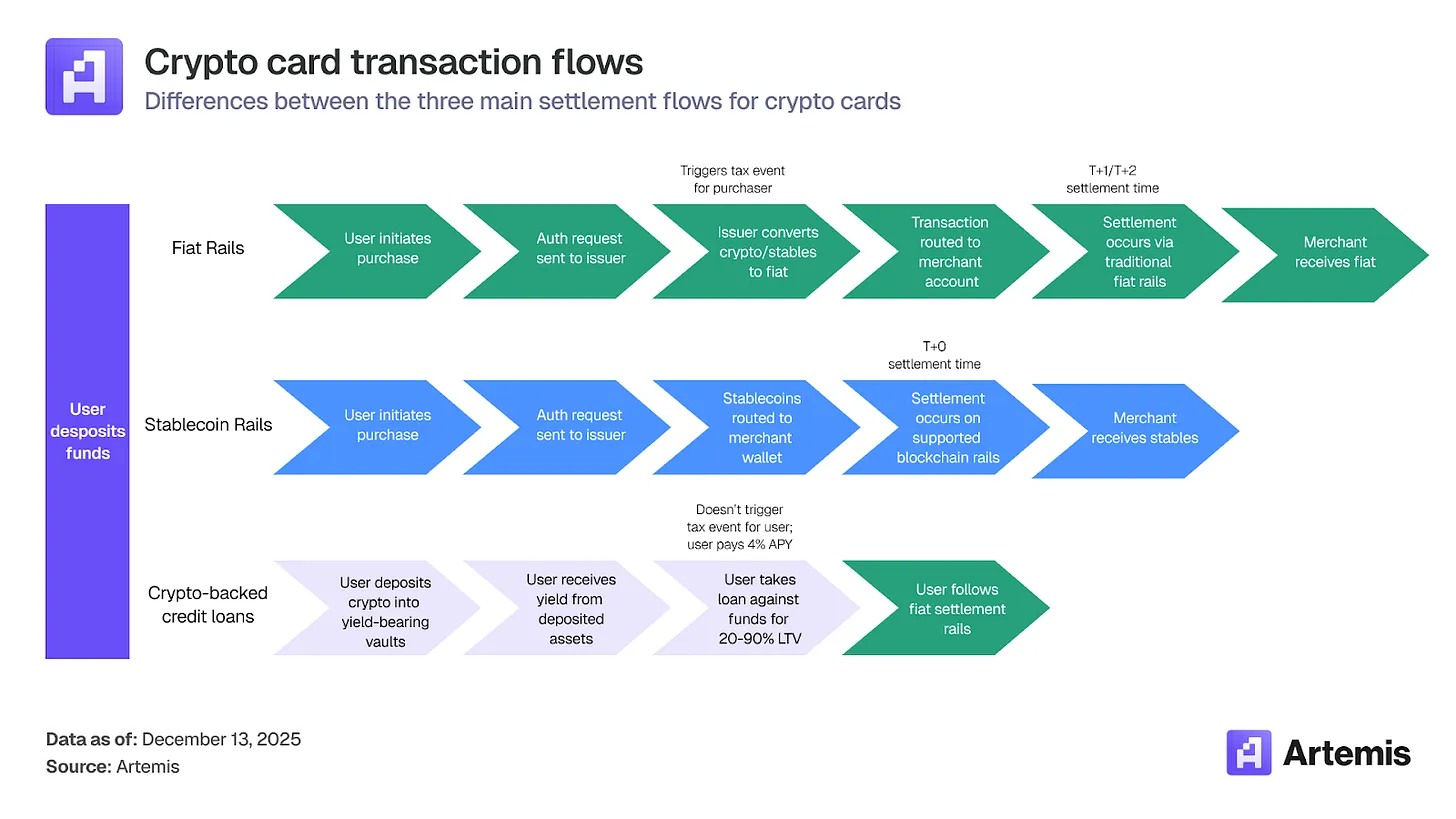
Currently, the vast majority of crypto card transactions settle via traditional fiat rails. The crypto-to-fiat conversion happens before reaching the payment network level, making these transactions indistinguishable from regular card payments to merchants. This approach requires no merchant integration and leverages existing infrastructure.
However, stablecoin settlement is gaining momentum. Visa’s stablecoin-linked card spend reached a $3.5 billion annualized run rate in Q4 FY2025, representing 460% year-over-year growth. While this accounts for approximately 19% of total crypto card settlement volume, the trajectory suggests stablecoin-native settlement will play an increasingly important role.
P2P Stablecoins vs. Crypto Cards in Africa
The African market presents an interesting dynamic between P2P stablecoin transfers and crypto card adoption. While global data shows crypto cards overtaking P2P transfers, in Africa, both payment methods are experiencing simultaneous explosive growth, serving complementary use cases.
P2P Stablecoin Strengths in Africa:
• Cross-border remittances: Stablecoin transfers average 0.5-1% fees compared to the Sub-Saharan Africa average of 8.78% for traditional remittances
• Direct peer-to-peer transactions without intermediaries
• Integration with mobile money platforms like M-Pesa through services like Kotani Pay
• Inflation hedging through dollar-denominated savings
Crypto Card Advantages in Africa:
• Merchant acceptance at millions of existing Visa/Mastercard terminals
• No need for merchant crypto education or integration
• Familiar card payment experience for consumers
• Access to global e-commerce platforms
Companies like Yellow Card, which operates in 20 African countries and doubled its annual transaction volume from $1.5 billion in 2023 to $3 billion in 2024, demonstrate how both payment methods can thrive. The platform enables seamless exchange between fiat and cryptocurrency, supporting both P2P transfers and card funding.
Global Market Dynamics and Future Outlook
Why Emerging Markets Lead Adoption
The Artemis report identifies three key markets where stablecoin cards solve tangible problems: India with $338 billion in crypto inflows (though 95% is offshore due to harsh taxation), Argentina with 46.6% USDC share for inflation hedging, and across Africa where currency volatility drives adoption.
In these markets, crypto cards arent competing with robust traditional financial infrastructure they are filling critical gaps. For a Nigerian business owner, holding working capital in USDT protects against naira volatility. For a Kenyan freelancer, receiving payment in USDC and cashing out via M-Pesa provides faster, cheaper settlement than traditional banking.
Developed Markets: A Different Opportunity
In developed markets like the United States and Europe, crypto cards face different dynamics. Traditional card infrastructure works well, and the opportunity lies in capturing a differentiated user segment rather than solving unmet needs.
The stablecoin-holding user base, while small relative to total card users, exhibits characteristics traditional issuers should value: higher financial engagement, willingness to adopt new products, growing digital asset balances, and behavioral data that enables new underwriting approaches.
Crypto-native platforms like Coinbase, Gemini, and emerging players like Ether.fi are capturing this segment with cards offering crypto cashback rewards and yield opportunities. Traditional issuers have advantages in scale, brand trust, and credit underwriting those who combine these with stablecoin capabilities may capture significant market share.
The Question of Direct Merchant Acceptance
As stablecoin adoption accelerates, some industry observers question whether crypto cards will remain relevant once merchants accept stablecoins directly. The Artemis report offers a nuanced perspective: direct merchant acceptance faces insurmountable bootstrap problems in most markets.
Card networks provide fraud protection, dispute resolution, consumer credit, rewards programs, and purchase protections services that stablecoin payments dont inherently offer. For the average consumer and merchant, cards remain the path of least resistance.
The report concludes that crypto cards represent a synthesis: cards provide ubiquitous acceptance while stablecoins provide superior cross-border value storage. Rather than competing, they complement each other store value in stables, spend anywhere with cards.
Looking Ahead: The Infrastructure for Mainstream Adoption
The Artemis reports findings represent more than statistics about payment volumes. They reveal a fundamental transformation in how cryptocurrency is moving from a speculative asset class to everyday payment infrastructure.
With 106% annual growth, crypto cards have evolved from a niche product to a mainstream payment method rivaling P2P transfers. This growth is particularly pronounced in emerging markets where crypto cards solve real problems currency volatility in Nigeria, expensive remittances across Africa, and limited banking access in rural areas.
The emergence of full-stack issuers, the maturation of stablecoin settlement infrastructure, and the regulatory clarity emerging in markets like Kenya all point toward continued expansion. Major payment networks are investing heavily: Visa’s stablecoin settlement grew 460% year-over-year, Mastercard is exploring African fintech partnerships, and traditional banks are beginning to take notice.
For Africa specifically, the convergence of mobile money infrastructure, crypto adoption, and regulatory evolution creates unprecedented opportunities. The continent’s digital payments market is projected to reach $1.5 trillion by 2030, and crypto cards are positioned to capture a meaningful share of this growth.
As Patrick Kim, the Artemis report’s author, concludes, Crypto cards are infrastructure for the next phase of stablecoin adoption: store value anywhere with stables, spend anywhere with cards.
The numbers suggest he’s right. The question isn’t whether crypto cards will continue growing it’s how fast traditional financial institutions will adapt to this new reality.