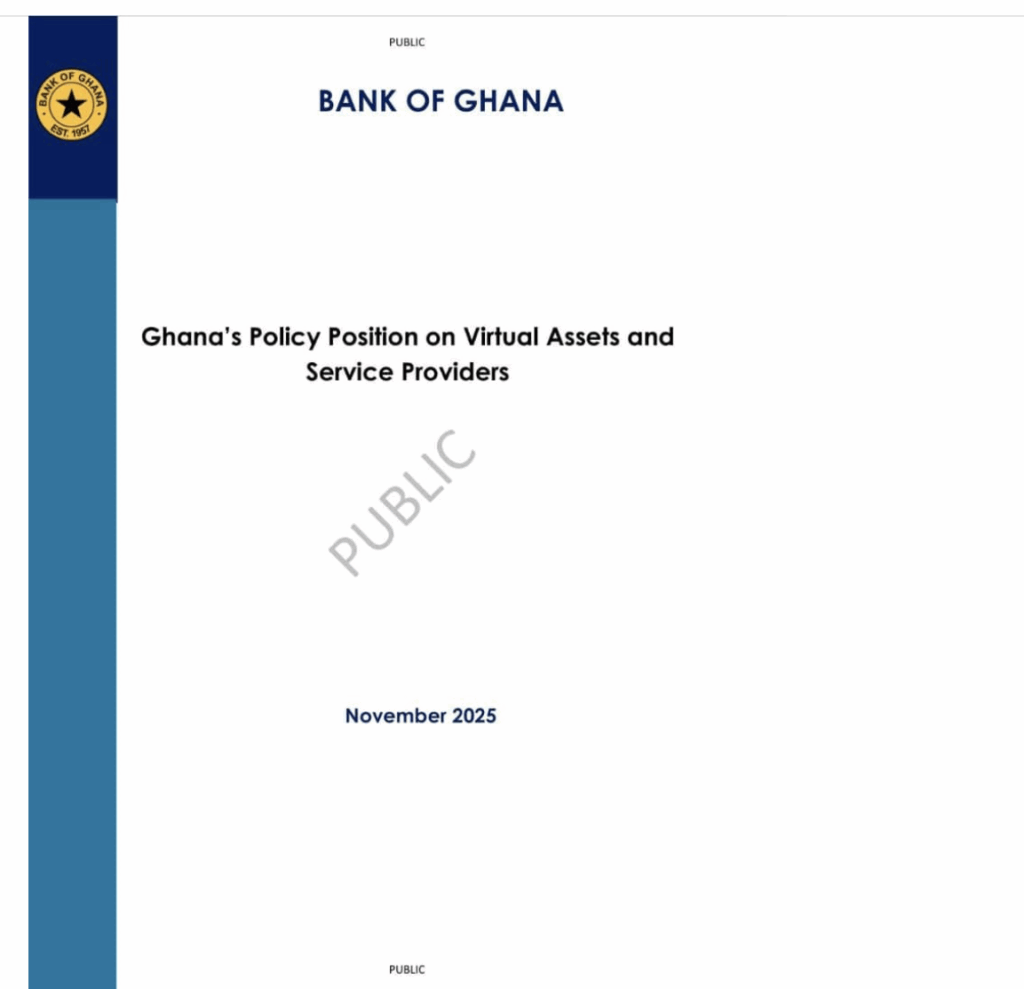
The Bank of Ghana has released a policy document titled “Ghana’s Policy Position on Virtual Assets and Service Providers.”
The document outlines a regulatory framework for cryptocurrencies and related technologies, proposing a risk-based approach to regulation rather than an outright ban.
“The Bank recognizes that virtual assets can no longer remain outside Ghana’s financial regulatory remit.”
The Governor of the Bank of Ghana had previously disclosed during a meeting with the International Monetary Fund (IMF) in October that the country would have a crypto regulation by the end of the year, following the confirmation of the completion of the Virtual Assets Service Provider (VASP) bill.
Notably, the bank reaffirmed its virtual assets shall not be recognized as legal tender in the country.
However, acknowledging the growing cryptocurrency market in Ghana, the bank has shifted from its previous cautious stances in 2018 and 2022. The country is now exploring approaches to regulate the cryptocurrency sector without stifling innovation.
Towards a Risk-Based and Activity-Specific Regulation
The proposed framework rests on certain guiding principles, including a risk-based, activity-specific approach to regulation.
For virtual asset service providers offering high-risk services, a license with stricter requirements will be required to operate.
Service providers offering low-risk services do not need a strict license; instead, they only require a simple registration with the bank, and currently, over 100 virtual asset service providers are registered.
Regulation will also be activity-based, classifying VASPs based on their functions, such as custody, remittance, or exchange.
Thus, the level of regulatory scrutiny towards any VASP will depend on the activities provided and the associated risk factors.
Eight Key Recommendations for a Progressive Regulatory Framework
The document outlined eight key policy recommendations that will shape Ghana’s virtual assets regulatory framework.
Licensing and Registration
Every company providing virtual asset services must be registered and licensed, depending on their activities, with the Securities and Exchange Commission (SEC) or the BOG.
Adherence to International Standards
The virtual asset regulation will be built upon Ghana’s Anti-Money Laundering Law (2020) and will align with the global practices and standards of the International Monetary Fund (IMF) and the Financial Action Task Force (FATF).
Travel Rule
Every VASP will be required to comply with FATF’s Travel Rule, collecting and sharing accurate sender and receiver details to ensure traceability.
Regulatory Clarity
The document clearly delineates the responsibilities of each regulatory body.
The BOG will oversee payments, storage, and financial stability; the SEC will regulate investment and trading; and the Finance Intelligence Centre (FIC) will enforce AML/CFT compliance. Serious violations would attract criminal punishment.
Establishing the Virtual Assets Regulatory Office (VARO)
For supervisory purposes, the document states that a new office will be established, the Virtual Assets Regulatory Office (VARO).
The office shall also operate in collaboration with other governmental institutions such as the SEC, FIC, the Ghana Revenue Authority (GRA), and the National Communications Authority (NCA) to ensure adherence with other related laws.
Constant Monitoring
There will be continuous monitoring and supervision of the virtual assets ecosystem to easily detect illicit activities, if any, and intervene promptly.
Not Legal Tender
The document has reiterated Ghana’s former position that cryptocurrencies shall not be recognized as legal tender in Ghana.
Literacy Program
The policy document proposes a National Virtual Assets Literacy Initiative (NaVALI), a literacy program to be developed in partnership with the SEC and the Ministry of Education.
The initiative aims to promote public awareness and financial literacy among young citizens.
Ghana’s Regulatory Route: A Precedent for African Countries
Ghana’s move towards a progressive regulation that exercises reasonable caution but balances innovation and growth sets a valuable precedent for other African countries.
By fostering a collaborative environment among relevant institutions, enhancing public awareness and education, and implementing precautionary measures against financial crimes and manipulation, Ghana aims to create a balanced crypto environment that supports blockchain innovation without compromising financial stability and consumer protection.
The BOG has emphasized its neutral stance on cryptocurrency, one that is neither hostile nor friendly, but an approach that moves away from a complete ban to a focus on responsible innovation consistent with global financial practices.
If successfully implemented, this regulatory framework could position Ghana as one of the most progressive crypto regulators in Africa.