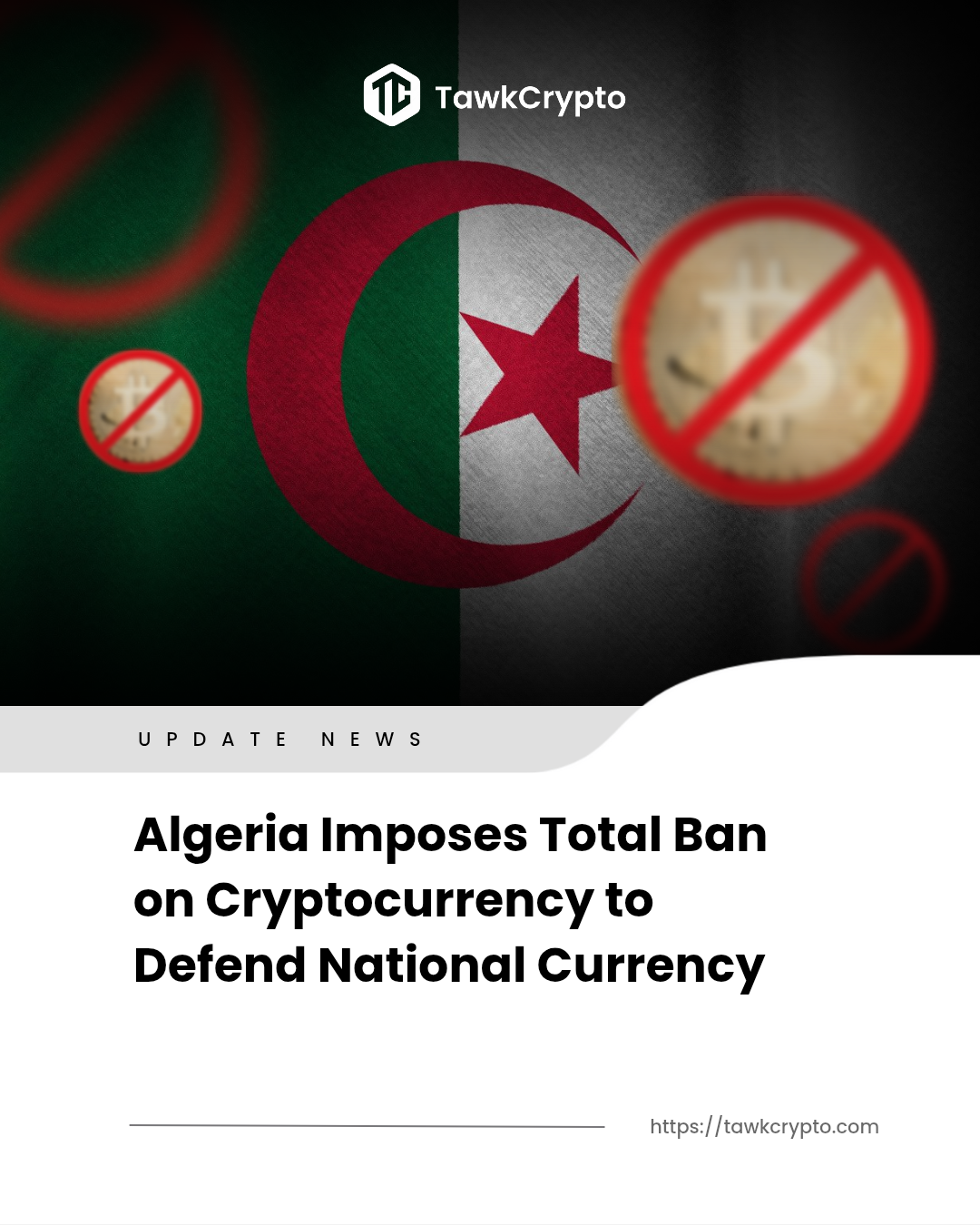
The Algerian government has implemented one of the world’s most sweeping cryptocurrency bans, outlawing all digital asset activities to safeguard the Algerian Dinar and tighten control over the country’s financial system.
The measure, officially enacted on July 24, 2025, was published in the Official Journal under a new provision, Article 6 bis. The government cites combating terrorist financing, preventing financial fraud, and curbing speculative trading as the primary reasons for the ban.
This decisive move positions Algeria as an outlier in the global regulatory landscape, where most nations, including those in Africa, are increasingly leaning toward regulated crypto markets rather than outright prohibition.

A Complete Prohibition of Crypto in Algeria
While Algeria has technically restricted cryptocurrency since 2018, previous legislation was loosely worded and inconsistently enforced. The 2025 update leaves no room for interpretation; the country’s crypto ecosystem is now fully illegal.
The law prohibits:
- Issuing: Launching or creating any cryptocurrency or token.
- Buying or Selling: Engaging in any crypto trading activities.
- Using: Making payments or transactions with digital assets.
- Holding: Possessing virtual currencies, regardless of intent.
- Trading: Participating in speculation on cryptocurrency prices.
- Promoting: Marketing, advertising, or publicly endorsing crypto.
- Platform Operations: Running or managing a crypto exchange.
- Mining: Using computing power to validate transactions or generate coins.
In short, any action involving cryptocurrency, from casual ownership to full-scale operations, is now punishable under Algerian law.
Penalties: Fines and Prison Sentences
Violations fall under Article 31 bis, with penalties ranging from two months to one year in prison. Courts may also impose fines between 200,000 DA and 1,000,000 DA (€1,300–€6,700). Judges have discretion to issue both imprisonment and financial penalties, signaling the government’s intent to enforce the law rigorously.
This transforms crypto activity from a grey area into a criminal offense, effectively shutting down the sector within Algerian borders.
Algeria’s Stance in the Global Context
Globally, the ban stands in stark contrast to trends in other regions.
- Europe is advancing with the Markets in Crypto-Assets (MiCA) regulation, aimed at harmonizing crypto laws and fostering industry growth.
- The UAE and Bahrain are actively courting blockchain firms and building crypto-friendly regulatory frameworks.
- El Salvador has gone so far as to adopt Bitcoin as legal tender, while the United States continues its piecemeal but ongoing regulatory approach.
Algeria’s hardline stance instead echoes the policies of countries like China, which have opted for comprehensive bans to maintain strict control over their monetary systems.
Impact on Algeria’s Crypto Community
For Algeria’s growing but discreet crypto users, many of whom turned to digital assets to hedge against inflation and access global financial markets, the ban represents a significant setback.
Industry observers predict that some activity will move underground, relying on VPNs, peer-to-peer trading, and offshore exchanges to bypass restrictions. Others may abandon the space entirely due to the risk of prosecution.
The government, however, remains firm in its belief that the ban is essential to protect national monetary sovereignty and prevent the misuse of financial technology for illicit purposes.
Bottom line: Algeria has drawn a clear line in the sand, one that could either insulate its economy from crypto-related risks or push innovation and capital toward more crypto-friendly jurisdictions.
Read also Top 5 Crypto Exchanges in South Africa (2025)