
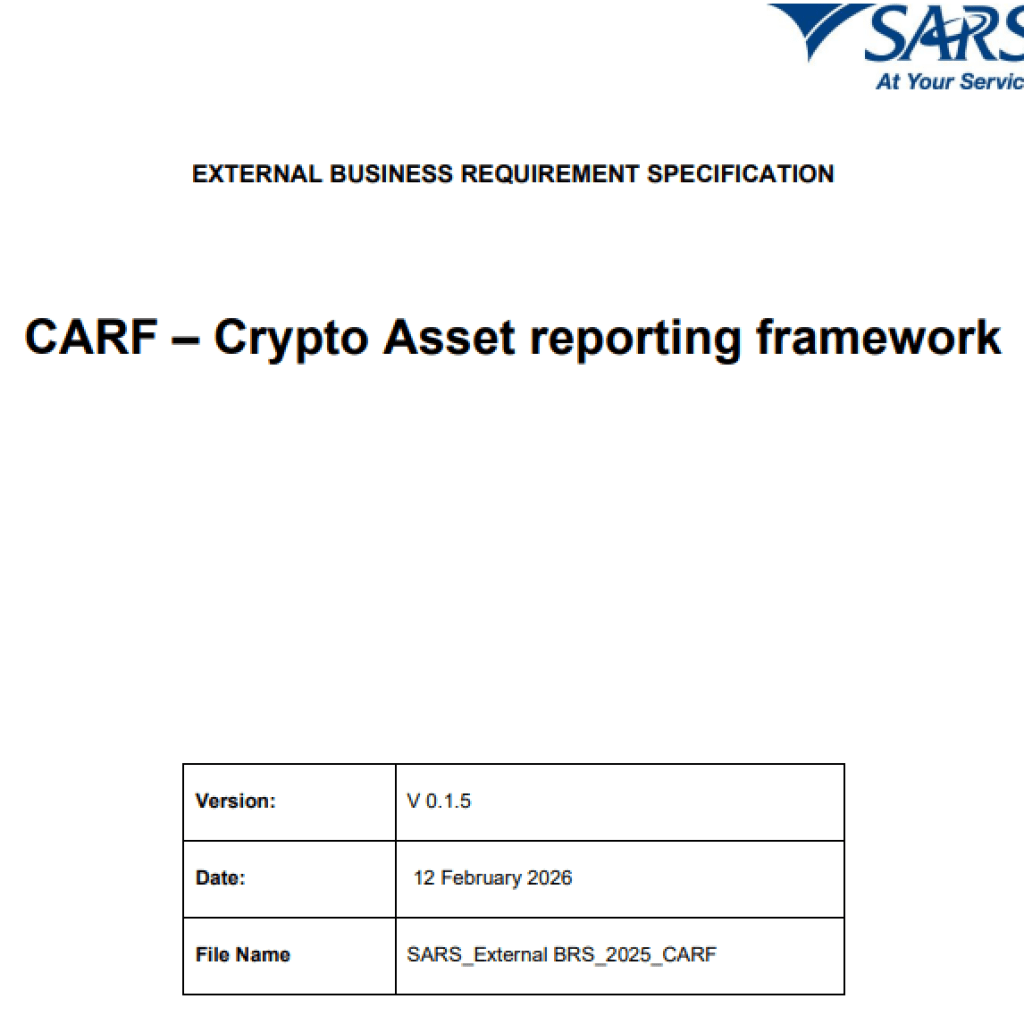
The South African Revenue Service (SARS) has published version 0.1.5 of its Crypto-Asset Reporting Framework (CARF) External Business Requirement Specification (BRS), laying out the technical requirements for how crypto service providers must report user and transaction data for tax purposes.
The document, released this week, marks a significant regulatory step for South Africa’s crypto sector and places the country among the early adopters of the OECD’s international crypto tax transparency standard.
Domestic crypto reporting is set to begin in September 2026, with automatic international information exchange to follow by September 2027.
What Is CARF?
CARF is a tax transparency framework developed by the Organisation for Economic Co-operation and Development (OECD), designed to give tax authorities cross-border visibility into crypto transactions, mirroring the way banks report financial account data under the existing Common Reporting Standard (CRS).
South Africa’s adoption of the framework signals its commitment to aligning with international regulatory standards as crypto assets become an increasingly significant part of the financial system.
What the Rules Require
Under the new specification, entities classified as Reporting Crypto-Asset Service Providers (RCASPs), including exchanges and certain crypto intermediaries, will be required to collect detailed customer identification information, record crypto transactions including transfers and exchanges, submit structured data reports to SARS using prescribed XML formats, and apply due diligence procedures to verify user information.
The BRS is primarily a technical implementation guide, detailing how reporting systems must be built and how data must be formatted before submission to SARS. While the document is highly technical in nature, the compliance obligations it introduces represent a material shift for businesses operating in South Africa’s crypto market.
Key Dates
SARS has outlined a two-phase implementation timeline. Domestic crypto reporting is expected to begin in September 2026. Automatic international information exchange, through which SARS will share data with foreign tax authorities in other CARF-participating jurisdictions, is expected to commence by September 2027.
The timelines put South Africa ahead of many developing markets in implementing the OECD framework and signal a clear regulatory direction for the sector.
Will This Slow Crypto Adoption?
Historically, clearer regulation has often reduced uncertainty rather than suppressed growth.
In markets where crypto operates in legal grey zones, institutional players hesitate. Structured reporting frameworks like CARF may create short-term friction, but they also:
- Reduce compliance ambiguity
- Encourage institutional participation
- Improve banking relationships for exchanges
- Strengthen consumer protections
In other words, while informal crypto activity may decline, regulated growth could accelerate.