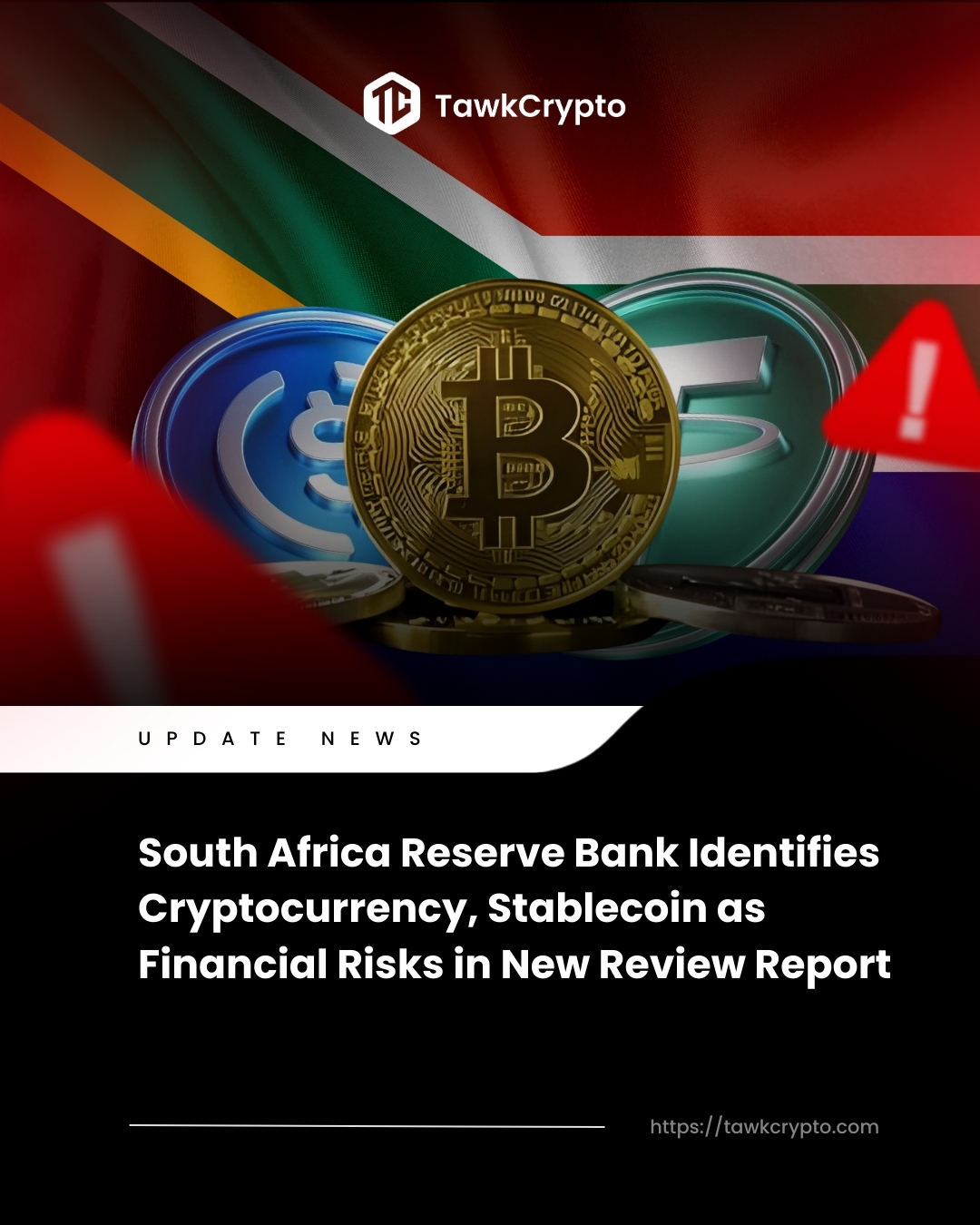
In its latest Financial Stability Review (FSR), the South African Reserve Bank (SARB) flagged stablecoins and cryptocurrencies as emerging risks to the country’s financial stability.
The report details that, as of July, three major crypto exchanges in South Africa, Luno, VALR, and Ovex, had a combined user base of 7.8 million people. These users collectively held about $1.5 billion in custody towards the end of 2024. This data was gathered through a survey to assess the prevalence of digital asset trading within the country.
The bank highlighted that these figures capture activity in both major volatile cryptocurrencies and stablecoins. It also noted an increase in stablecoin trading activity since 2022, indicating a shift in market behaviour.
Whereas Bitcoin and other popular crypto assets were the main conduit for trading crypto assets until 2022, USD-pegged stablecoins have become the preferred trading pair on South African crypto asset trading platforms […] This is due to the notably lower price volatility of stablecoins compared to unbacked crypto assets.
Absence of Clear Regulation
The SARB warned that the absence of a comprehensive regulatory framework for digital assets, including stablecoins and cryptocurrencies, creates gaps in the financial system that could allow these assets to bypass adequate oversight.
The report also emphasized that the borderless and digital nature of these assets increases their risk to financial stability and complicates regulatory supervision.
Due to their exclusively digital – and therefore borderless nature, crypto assets can be used to circumvent the provisions of the Exchange Control Regulations,
The Bank reiterated that South Africa has yet to establish a clear regulatory framework for crypto assets; therefore, undetected risks may emerge as crypto adoption expands, potentially affecting the broader financial system.
Cryptocurrency Regulation in South Africa: A Regulatory Shift Over the Years
In 2017, South Africa maintained a cautious stance toward cryptocurrencies, with the SARB warning that the issuance of digital currencies posed significant risks to the nation’s financial system.
This position shifted in 2021, when the International Fintech Working Group (IFWG) published a policy document confirming that crypto assets would be brought under regulatory supervision through a structured approach.
In 2022, the Financial Sector Conduct Authority (FSCA) formally classified crypto assets as financial products and subsequently began licensing digital asset service providers.
Crypto asset providers were also designated as accountable institutions under the Financial Intelligence Centre Act (FICA), making them subject to anti-money laundering (AML), counter-terrorist financing (CFT), and anti-proliferation financing requirements.
In May 2025, the Pretoria court gave a ruling on the applicability of South Africa’s exchange control rules to cryptocurrencies.
Cryptocurrency is not money. The construction that cryptocurrency is money, by looking at the definition of money, which includes foreign currency, is strained and impractical. Cryptocurrency is an asset that is bought and sold. There are practical challenges and implications if cryptocurrency is viewed as money.”
On this ground, the court ruled that crypto assets were exempted from South Africa’s exchange controls, although the judgement is currently under appeal by the SARB.
New Regulation In Progress
The SARB and National Treasury are currently drafting new rules to tighten oversight of cross-border crypto flows and ensure that digital assets fall within the ambit of exchange control rules.
The Finance Minister, Enoch Godongwana, confirmed the work in progress, noting that the framework will address the use of crypto assets for international transactions, including related administrative and reporting obligations for service providers.

The National Treasury, through the Financial Regulators Steering Committee, comprising the SARB, FSCA, Prudential Authority, and the National Treasury, will coordinate further discussions.
In September, South Africa published new draft regulations under the Tax Administration Act 2011 to enhance the transparency of crypto-asset reporting, aligning with the OECD’s Crypto-Asset Reporting Framework (CARF).
The Risk of Stablecoin to the Financial Economy and Monetary Sovereignty
The European Central Bank (ECB) recently warned that the rapid stablecoin growth could reduce traditional financial-sector funding, leaving them more vulnerable to market shocks.
In the statement released by the ECB, it noted that the depegging of USD-based stablecoins, which form the bulk of the stablecoin market, could trigger a sell-off of dollar reserves, potentially affecting the U.S. Treasury.
The governor of the SARB also echoed similar concerns about the potential impact of stablecoins on the monetary sovereignty of African states in an interview with CNBC Africa.

He noted that the rise in adoption of stablecoins in Africa came from countries with a shortage of foreign exchange. He also questioned the claims that stablecoins are actually ‘stable’ and the ‘supposed security’ of the U.S. Treasury.
I have a problem with the name ‘stablecoins’ because I am not sure that they are quite [as] stable as they are made out to be… At the moment, US Treasuries are seen as safe assets, but there are questions about how safe is the safe asset.
Instead, he emphasized the need to strengthen African fiat currencies to restore confidence in the region’s financial systems, as opposed to a complete ban on the use of cryptocurrency.
The Way Forward: Balancing Innovation and Oversight
Stablecoins have continued to grow rapidly and, as rightly noted, could pose structural risks to established financial markets. However, this growth appears inevitable, as institutional investors and traditional financial corporations increasingly adopt stablecoin infrastructure across Africa and globally.
Stablecoins offer relatively stable value and enable seamless, low-cost, and borderless transactions, making them appealing to individuals as a hedge against inflation and as a seamless settlement and remittance option for institutions.
It is neccesary that proactive measures are taken to ensure that digital-asset and traditional-finance infrastructures coexist and complement each other. These include collaboration between key stakeholders, robust education and awareness initiatives, and a comprehensive regulatory framework subject to continuous amendment based on technological advancements and concurrent risks.