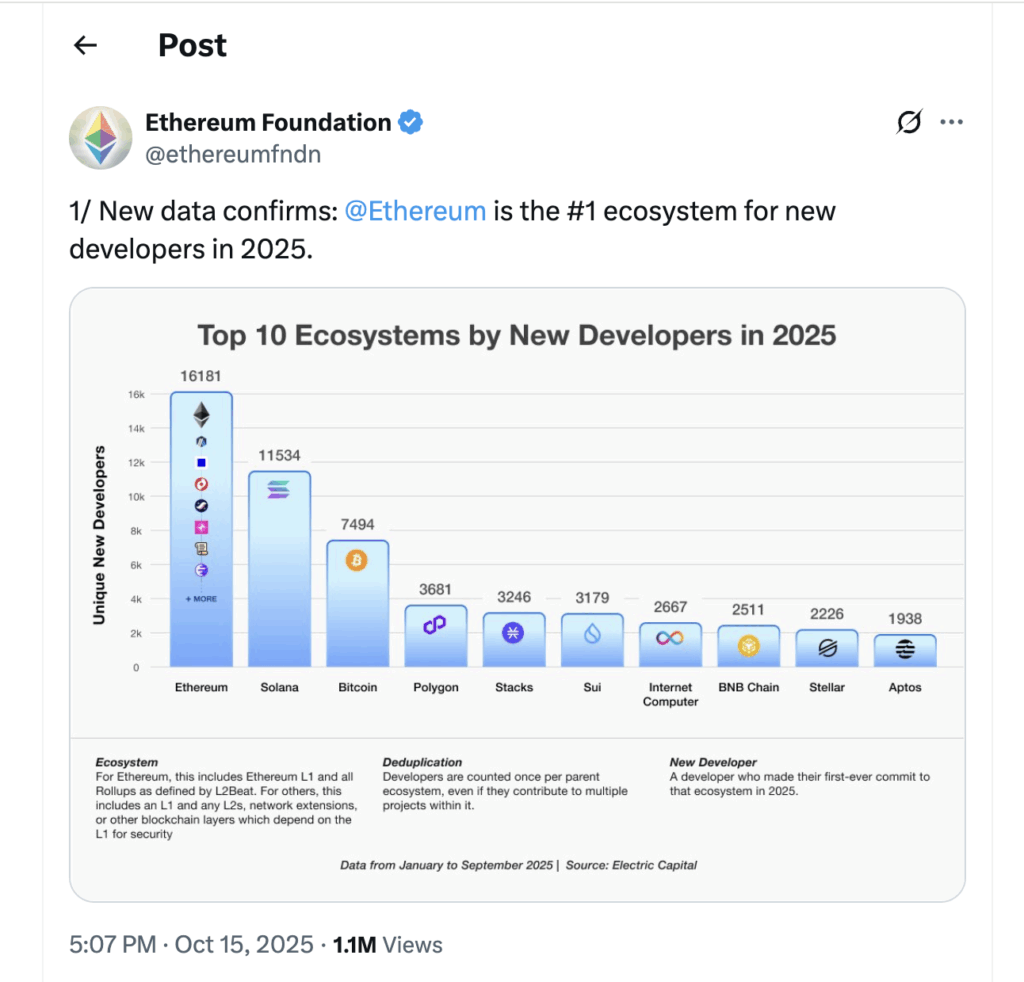
According to a recent report published by Electric Capital, Ethereum experienced the highest influx of developers, attracting 16,181 new developers between January and September 2025. It further noted that Ethereum has the largest and most active developer base across all blockchain networks. Currently, Ethereum has over 31,800 developers, with Solana and Bitcoin following with 17,708 and 11,036 developers, respectively.
A complementary report shared by the Ethereum Foundation showed similar trends, noting that Ethereum takes the lead as the home for new developers. It ranked Solana second with 11,534 new developers, while Bitcoin placed third with 7,494 new developers.
The Electric Capital report also geographically analyzed web3 developer activity. The regional analysis revealed that Asia recorded the largest growth of new developers at 43.5%, accounting for 33.2% of total web3 developers. Africa ranked in 4th place, contributing to 9.8% of new developers and 6.6% of all web3 developers globally.

Nigeria emerged as Africa’s top contributor, accounting for more than half of the total web3 developers in Africa. The country contributed to 5.7% of new developers globally, representing 3.8% of all web3 developers, although only 3% work full time. This positions Nigeria fourth globally in web 3 developer activity, following the United States who ranked first with 16.4%, India came second place at 13.5%, and the United Kingdom third place at 4%.
Nigeria has made remarkable progress in web 3 developer activity within the last decade, moving from 81st position globally with almost no developer activity in 2015 to a top-five position globally. This signifies the rapid and growing adoption of blockchain technologies and developer activity over the past decade.

A report by Hashed Emergent, a venture capital firm accelerating web 3 adoption in Africa, highlighted the rapidly evolving web 3 ecosystem in Nigeria in its report, ‘Nigeria Web3 Landscape’. The report revealed that Nigeria contributed 4% of all global new web3 developers, the highest from any country in Africa.
Remarkably, 86% of Nigerian developers are under the age of 27, and over half joined the ecosystem in the past 12 months. The report further cited that only 15% of the developers report full-time roles, while 41 percent identify as freelancers. It added that the country recorded a 28% increase in developers in 2024, reaching 1.1 million total developers.
The chief executive officer and managing partner at Hashed Emergent, Tak Lee, had noted,
‘Nigeria’s momentum in web 3 adoption will not only shape the future of digital innovation locally but also serve as a catalyst, leapfrogging Africa to the forefront of the global web 3 economy.”
The same report also examined crypto transactions, noting that the USDT/NGN pair was the most traded on centralized exchanges, with stablecoin transfers in Nigeria almost reaching $3 billion in the first quarter of 2024. The report acknowledged the expansion of cryptocurrency and blockchain technology beyond retail trading into public sectors in areas such as identity verification, land registries, education records, and the healthcare system. However, it stressed that integration into existing systems and regulatory clarity remain key obstacles limiting the acceleration and adoption of blockchain technology in the country.
Similarly, in 2024, Chainalysis ranked Nigeria second globally for overall crypto adoption, with $59 billion received in crypto value, of which $24 billion was in stablecoins. However, its 2025 report revealed that Nigeria dropped to sixth position, ranking behind India, the United States, Pakistan, Vietnam, and Brazil in that order. The overall rank was done considering indices such as Retail centralized service value received, centralized service value received, Defi value received, and institutional-sized transfers. Notably, Nigeria ranked third in Defi activity and remained the only African country in the top 20 for overall crypto adoption as reported by Chainalysis.

Nigeria’s decline in rank is less likely due to a reduced crypto transaction volume, but rather to lower institutional participation and an uncertain regulatory outlook compared to other leading countries.
Nigeria’s regulatory stance has evolved significantly in the past years, moving from the Central Bank of Nigeria (CBN)’s prohibitive approach to a less stifling and more supportive approach through legislation and policy actions. The Securities and Exchange Commission introduced the Accelerated Regulatory Incubation Program (ARIP) in the first quarter of the year. The program provided provisional licensing to Virtual Asset Service Providers (VASPs) with a full license approval after all regulatory requirements are met within the next 12 months.
Additional efforts include the Nigeria Tax Administration Act, which classifies cryptocurrency as taxable income, imposing a 30% tax on VASPs and requiring transaction reporting to tax authorities.
However, some of these regulatory decisions have received criticisms from blockchain advocates and crypto traders, particularly, the classification of cryptocurrency as securities by the new Investment and Securities Act 2025 and the SEC’s proposed $1 billion Naira capital requirements for VASPs. The House of Representatives ad-hoc committee on the economic, regulatory, and security implications of cryptocurrency adoption and point-of-sale (POS) operations has recently criticised the capital requirement for virtual assets service providers (VASPs), labelling it ‘prohibitive’
While Nigeria has made remarkable progress towards clearer cryptocurrency regulation, further clarifications and amendments are necessary to ensure effective regulatory oversight while maintaining the country’s vibrant crypto ecosystem, which has positioned it as a continental leader.