
Key Takeaways:
- South Africa and Nigeria removed from FATF grey list after nearly three years
- Mozambique and Burkina Faso also graduate from heightened monitoring
- Crypto regulations played crucial role in meeting compliance standards
- Move expected to reduce remittance costs and boost foreign investment
- Experts warn sustained vigilance needed to maintain reforms
Breaking Down the FATF Decision
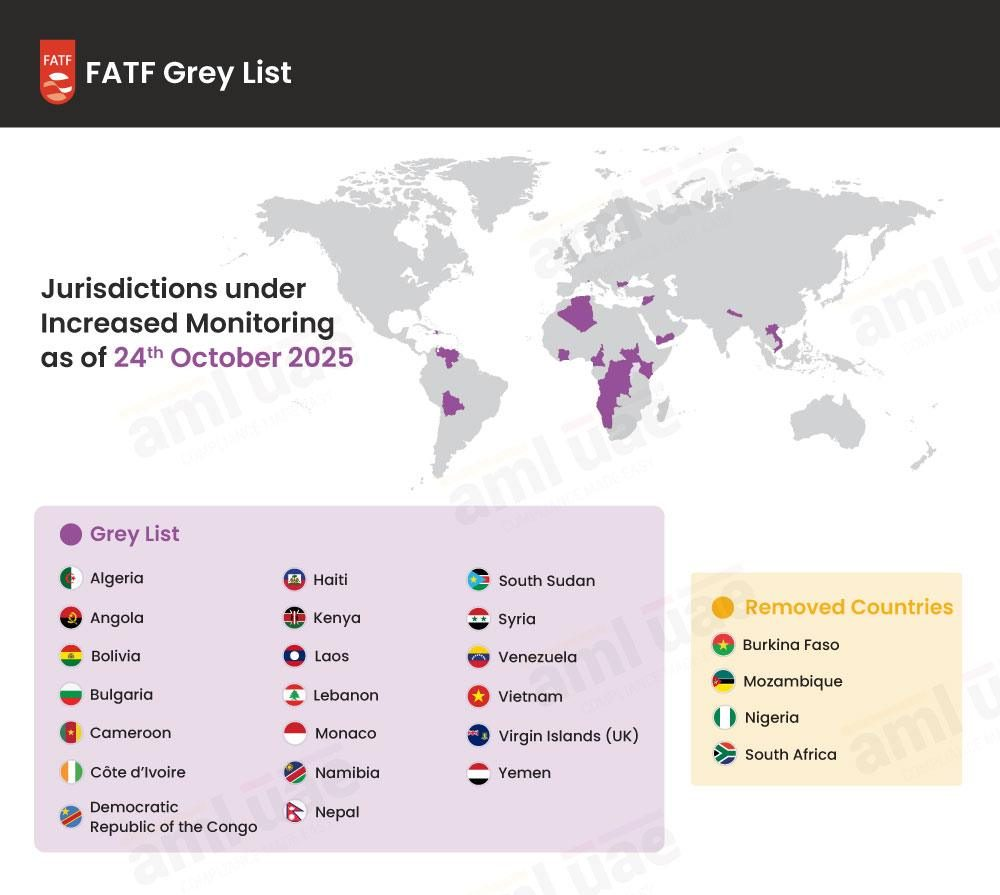
The Financial Action Task Force (FATF), a Paris-based global watchdog that sets international standards for combating money laundering and terrorist financing, announced on Friday that four African countries, South Africa, Nigeria, Mozambique, and Burkina Faso, are being removed from its grey list of jurisdictions under increased scrutiny.
The delisting represents a significant milestone for two of Africa’s largest economies, which had been placed on the heightened monitoring framework in February 2023. The designation had raised concerns among international investors and increased compliance costs for cross-border financial flows.
What the Grey List Means for Countries
Being placed on the FATF grey list doesn’t prohibit a country from participating in global finance, but it does trigger several practical consequences that can hamper economic growth:
Increased scrutiny on transactions: Banks and financial institutions in other countries apply enhanced due diligence when processing payments to and from grey-listed jurisdictions, slowing down transactions and increasing costs.
Higher remittance fees: Money transfer services often charge premium rates for transfers to grey-listed countries, directly impacting millions of families who depend on remittances.
Investor hesitation: The designation signals elevated risk, making international investors more cautious about committing capital to businesses and projects in affected countries.
Reputational damage: The grey list carries a stigma that can undermine confidence in a country’s financial system and governance structures.
Africa’s Progress on Financial Crime Prevention
According to FATF President Elisa de Anda Madrazo, speaking at the Paris plenary session: “This plenary has been a positive story for the continent of Africa.”
The four countries join at least seven other African nations that remain under FATF monitoring as of the last update in October 2023:
- Cameroon
- Democratic Republic of Congo (DRC)
- Mali
- Senegal
- South Sudan
- Tanzania
- Uganda
The successful exit of South Africa, Nigeria, Mozambique, and Burkina Faso demonstrates that sustained reform efforts can yield tangible results in relatively short timeframes.
South Africa’s Path to Compliance
South Africa’s journey off the grey list was shaped by its determination to overcome institutional weaknesses that had developed during what officials termed the “state capture era”, a period marked by alleged corruption and the hollowing out of key enforcement agencies.
Key Reforms Implemented:
Strengthened institutional oversight: Government agencies and regulators embarked on comprehensive reforms to rebuild oversight capacity of financial institutions, improving monitoring and enforcement capabilities.
Enhanced inter-agency coordination: Different regulatory bodies improved information sharing and collaborative investigations, closing gaps that criminals had exploited.
Cryptocurrency regulation framework: In February 2025, South Africa introduced comprehensive crypto regulations, bringing digital assets under regulatory supervision. This framework included:
- Registration requirements for crypto service providers
- Anti-money laundering (AML) and counter-terrorist financing (CTF) compliance obligations
- Know Your Customer (KYC) protocols for crypto transactions
- Enforcement mechanisms with meaningful penalties for violations
Beneficial ownership transparency: South Africa demonstrated that supervisory bodies could enforce effective sanctions and ensure authorities have timely access to accurate beneficial ownership information on legal entities, a critical FATF requirement.
The crypto regulations proved particularly important, as FATF had identified the digital assets sector as a potential vulnerability in many jurisdictions’ AML/CTF frameworks.
Nigeria’s Regulatory Evolution
Nigeria’s removal from the grey list signals to global partners that its institutions are increasingly aligned with international standards of transparency and cooperation.
Nigeria’s Reform Highlights:
Crypto regulatory framework: Following South Africa’s example, Nigeria enacted comprehensive cryptocurrency regulations that brought the previously loosely-regulated sector under formal oversight. The country had previously banned banks from servicing crypto businesses in 2021, but has since adopted a more nuanced regulatory approach.
Enforcement actions: Nigerian authorities demonstrated their commitment by taking enforcement actions against non-compliant entities, showing that regulations have teeth and are being actively implemented.
Financial intelligence improvements: The country enhanced its financial intelligence unit’s capacity to detect, investigate, and prosecute money laundering and terrorist financing cases.
Cross-border cooperation: Nigeria strengthened its collaboration with international partners on financial crime investigations, demonstrating commitment to global standards.
Economic Implications of the Delisting
The removal from the FATF grey list is expected to deliver tangible economic benefits for both South Africa and Nigeria:
Reduced Remittance Costs
With enhanced due diligence requirements lifted, money transfer services should see reduced compliance burdens, potentially translating into lower fees for remittances. This matters enormously for Africa, where remittance flows totaled over $100 billion in 2024, with Nigeria and South Africa among the top recipients.
For millions of families who depend on money sent home by relatives working abroad, even small percentage reductions in transfer fees can mean significant savings.
Improved Investment Climate
International investors who had been cautious about deploying capital in grey-listed jurisdictions may now reconsider. The delisting signals that these countries have functional regulatory frameworks and institutional capacity to combat financial crime, reducing perceived risk.
Foreign direct investment (FDI) flows, which had slowed during the grey-list period, could accelerate as the stigma lifts and transaction friction decreases.
Faster Cross-Border Payments
Banks and financial institutions in other countries will no longer need to apply enhanced due diligence for transactions involving South Africa and Nigeria, speeding up payment processing times and reducing administrative costs for businesses engaged in cross-border trade.
Strengthened Regional Leadership
As two of Africa’s three largest economies (alongside Egypt), South Africa and Nigeria’s success in exiting the grey list positions them as leaders in financial governance reform. Their experience could provide valuable lessons for other African countries still under FATF monitoring.
The Cryptocurrency Factor
The role of cryptocurrency regulation in achieving FATF compliance deserves special attention, as it represents an evolving challenge for regulators worldwide.
FATF has explicitly identified virtual assets and virtual asset service providers (VASPs) as potential vulnerabilities in countries’ AML/CTF frameworks. The organization updated its standards in 2019 to require countries to regulate crypto exchanges, wallet providers, and other digital asset businesses.
For South Africa and Nigeria, implementing robust crypto regulatory frameworks was not optional, it was essential to demonstrating comprehensive coverage of their financial systems.
What Effective Crypto Regulation Looks Like
Both countries’ frameworks included several elements that FATF considers essential:
Licensing and registration: Crypto businesses must register with authorities and meet minimum standards to operate legally.
Travel rule compliance: Following FATF’s “travel rule,” crypto service providers must collect and share customer information for transactions above certain thresholds, similar to traditional financial institutions.
Risk-based approach: Regulations proportionate to the actual money laundering and terrorist financing risks posed by different types of crypto activities.
Supervision and enforcement: Active monitoring of compliance with meaningful penalties for violations, not just regulations on paper but actual enforcement in practice.
Mozambique and Burkina Faso: Smaller Economies, Similar Challenges
While South Africa and Nigeria drew the most attention due to their economic size, Mozambique and Burkina Faso’s exits are equally significant for their respective circumstances.
Mozambique, still recovering from a devastating debt scandal that emerged in 2016, demonstrated that even countries facing severe economic challenges can implement effective AML/CTF reforms when political will exists.
Burkina Faso, grappling with security challenges from terrorist groups in the Sahel region, showed that countries can strengthen financial oversight even while confronting serious security threatsm, an important lesson for other nations in similar circumstances.
A Win for Africa, But Work Continues

The removal of South Africa, Nigeria, Mozambique, and Burkina Faso from the FATF grey list represents a significant achievement for African financial governance and economic development. The delisting should reduce transaction costs, improve investment climate, and strengthen these countries’ positions in the global financial system.
The critical role of cryptocurrency regulation in achieving compliance offers important lessons as digital assets continue growing across Africa. Countries that can balance innovation with integrity, enabling crypto adoption while preventing financial crime, will be best positioned for the digital economy future.
However, experts rightly caution that sustained vigilance is essential. The reforms that earned these countries their clean bill of health must be maintained and strengthened over time. Financial crime threats constantly evolve, requiring continuous adaptation of regulatory frameworks and enforcement capabilities.
For the seven African countries still on the grey list, the path forward is now clearer. With political will, comprehensive reforms, and sustained implementation, including robust crypto regulation, they too can achieve compliance with international standards and unlock the economic benefits that come with global confidence in their financial systems.
The story of South Africa and Nigeria’s journey off the FATF grey list is ultimately one of institutional rebuilding and regulatory maturation. It demonstrates that even countries facing serious governance challenges can implement effective reforms when leadership commits to the hard work required.
As Africa continues integrating into the global financial system while embracing digital innovation, the continent’s ability to maintain high standards of financial integrity will shape its economic future. Friday’s FATF announcement represents an important step in the right direction.