The latest ‘State of Crypto 2025’ report from Andreessen Horowitz (a16z) paints a defining picture of crypto’s new era, one of maturity, legitimacy, and mainstream adoption. The renowned Silicon Valley venture capital firm, known for backing projects like Coinbase, Uniswap, and Optimism, highlights that crypto has evolved far beyond the speculative bubble narrative.
According to the report, developing nations such as Nigeria, India, Argentina, and Colombia now account for the majority of actual on-chain activity, marking a historic shift in global digital finance.
Crypto Has Gone Mainstream
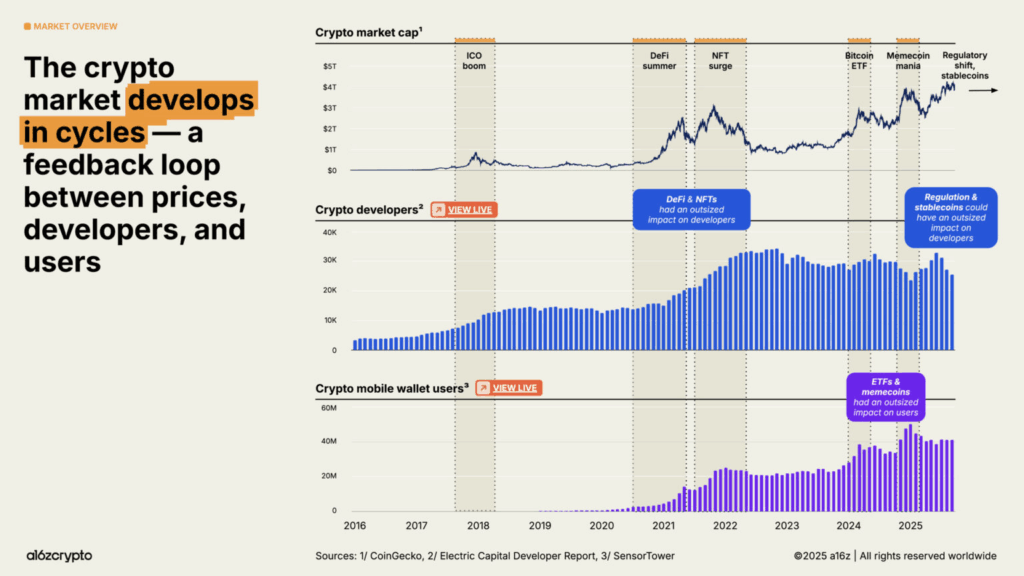
The report reveals that the total crypto market capitalization has crossed $4 trillion, with over 716 million people globally owning digital assets, a 16% jump from last year.
Crypto usage has transcended trading and speculation to become a daily financial tool, especially in emerging economies. In Nigeria, for instance, crypto wallets and stablecoins have become vital for payments, remittances, and inflation hedging, reflecting how decentralized finance is solving real-world problems.
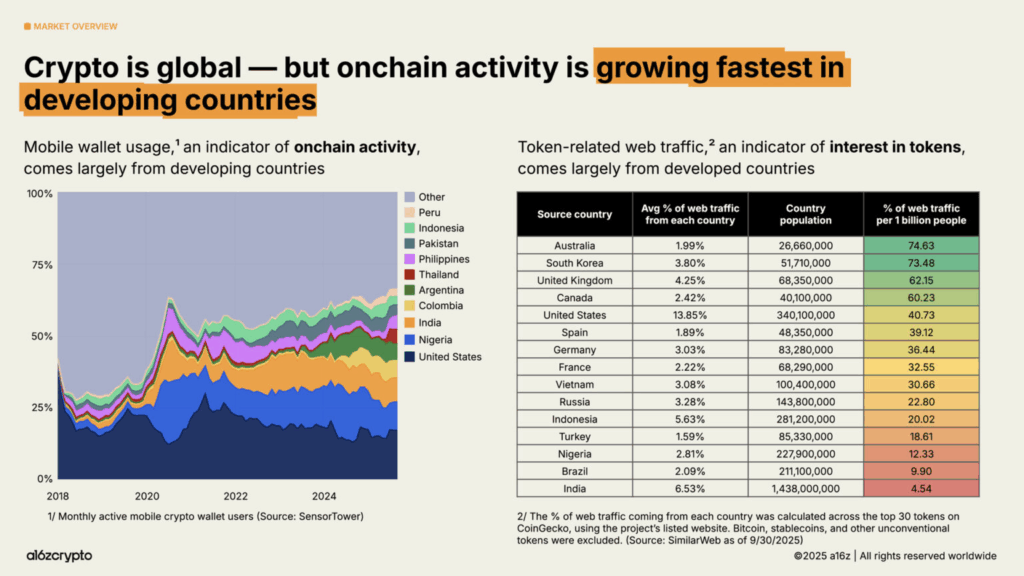
The report notes that Africa’s largest economy has consistently ranked among the top three countries worldwide for peer-to-peer (P2P) crypto transactions. Mobile-first users are embracing stablecoins as a safer, faster, and borderless financial medium.
Institutional Adoption at an All-Time High
a16z’s 2025 report highlights a sweeping institutional embrace of crypto assets.
From Visa and PayPal to BlackRock and Fidelity, traditional financial giants now operate crypto-integrated products or infrastructure. Over $175 billion in Bitcoin and Ethereum is held via exchange-traded products (ETPs), while public companies collectively hold 10% of circulating BTC and ETH on balance sheets.
This marks a stark departure from the risk-averse stance of past years, signaling that crypto is now a recognized global asset class.
Stablecoins: The New Financial Backbone
Stablecoins remain the defining story of 2025.
With $46 trillion in total transaction volume, up 106% year-over-year, stablecoins now rival the scale of major card networks. Even after filtering inflated data, a16z estimates $9 trillion in real on-chain transactions, and a total supply exceeding $300 billion.
Dominated by Tether (USDT) and USD Coin (USDC), stablecoins now represent over 1% of all U.S. dollars in circulation, backed by roughly $150 billion in U.S. Treasuries. This positions them as one of the most consequential financial innovations of the decade.
In Nigeria, stablecoins like USDC and cUSD are increasingly integrated into fintech ecosystems such as Finna and Yellow Card, bridging digital and fiat economies and supporting small businesses navigating inflation and currency volatility.
Policy and Regulation: The U.S. Catches Up
After years of policy uncertainty, the U.S. has made significant progress with frameworks like the GENIUS Act and CLARITY Act, offering clearer guidelines for token issuance and compliance.
This shift has restored America’s standing as a global crypto innovation hub, reversing the earlier exodus of capital and talent.
Meanwhile, African nations such as Nigeria and Kenya continue to refine their regulatory landscapes. Nigeria’s Securities and Exchange Commission (SEC) is developing frameworks to register and monitor Virtual Asset Service Providers (VASPs), a step aligned with global standards to balance innovation and oversight.
The On-Chain Economy Expands
The global on-chain economy, spanning decentralized exchanges (DEXs), tokenized assets, and real-world asset (RWA) tokenization, is scaling at record speed.
- 20% of global spot trading now occurs on DEXs.
- Tokenized RWAs (e.g., treasuries, real estate, private credit) have reached $30 billion, growing nearly 4x in two years.
- Decentralized Physical Infrastructure Networks (DePIN) are forecasted to reach $3.5 trillion by 2028, fueling on-chain innovation in telecom, transport, and renewable energy.
These trends underscore the transition from crypto as speculative trading to crypto as infrastructure, powering the digital economy.
Scaling the Blockchain Stack
The report details significant advances in blockchain infrastructure.
- Average throughput across major chains has surged from 25 tps to over 3,400 tps.
- Ethereum’s Layer-2 networks have slashed fees to fractions of a cent.
- Solana generated nearly $3 billion in on-chain revenue last year.
- Cross-chain protocols like LayerZero now enable seamless multi-chain interoperability.
- Zero-knowledge (ZK) systems are emerging as vital for privacy, scalability, and security.
This infrastructure maturity lays the groundwork for Web3 applications that can finally operate at internet scale, including payments, gaming, data markets, and AI integrations.
AI and Crypto Convergence
A notable highlight of the 2025 report is the growing synergy between AI and blockchain.
a16z argues that blockchains can solve AI’s core challenges: data provenance, authenticity, and value attribution. Projects like World ID, with over 17 million verified users, demonstrate how decentralized identity can authenticate humans in an AI-driven world.
The firm sees crypto and AI as mutually reinforcing technologies, with crypto providing transparent infrastructure for AI’s growing computational and financial systems.
Crypto’s Adulthood Phase
After nearly two decades of evolution, a16z concludes that crypto has entered its “adulthood phase.”
No longer defined by speculation, the industry is maturing into a multi-trillion-dollar ecosystem driving real economic value. The next frontier, the report notes, will be built around:
- Tokens generating sustainable on-chain revenue
- Stablecoins powering global commerce
- Consumer apps that make crypto invisible yet indispensable
Conclusion
Nigeria’s prominence in the a16z report underscores Africa’s pivotal role in crypto’s next chapter. From remittances to stablecoin payments, on-chain activity in Nigeria represents real-world utility, not hype.
As the global crypto market enters its maturity phase, developing nations like Nigeria are proving that the future of blockchain innovation may be written not in Silicon Valley, but in Lagos, Nairobi, and Buenos Aires.
Read also: Tether Invests in Kenya’s Fintech, Kotani Pay, to Enhance Africa’s Digital Infrastructure