The Global Initiative Against Transnational Organized Crime (GI-TOC) has released a report assessing the impact of the Central African Republic’s (CAR) repeated introduction of cryptocurrency-related projects.
The report titled ‘Behind The Blockchain, Cryptocurrency and Criminal Capture in the Central African Republic’ examines crypto policies introduced over the past three years, noting that they may jeopardize the country’s economic future and potentially attract foreign criminal actors.
According to the report, a large majority of CAR’s population lives in extreme poverty, faces ongoing security challenges, and has limited access to electricity and internet connectivity. It asserts that most citizens are unable to realize meaningful benefits from the various cryptocurrency projects launched by the government, as opposed to the government’s claims that these initiatives were introduced to improve public welfare.
This is corroborated by the World Bank Report on the Central African Republic, which states that nearly 70% of the country’s population live on less than $2.15 per day, and 90% live without electricity, ranking it as the 5th nation in the world with the highest poverty rate.
Bitcoin as Legal Tender
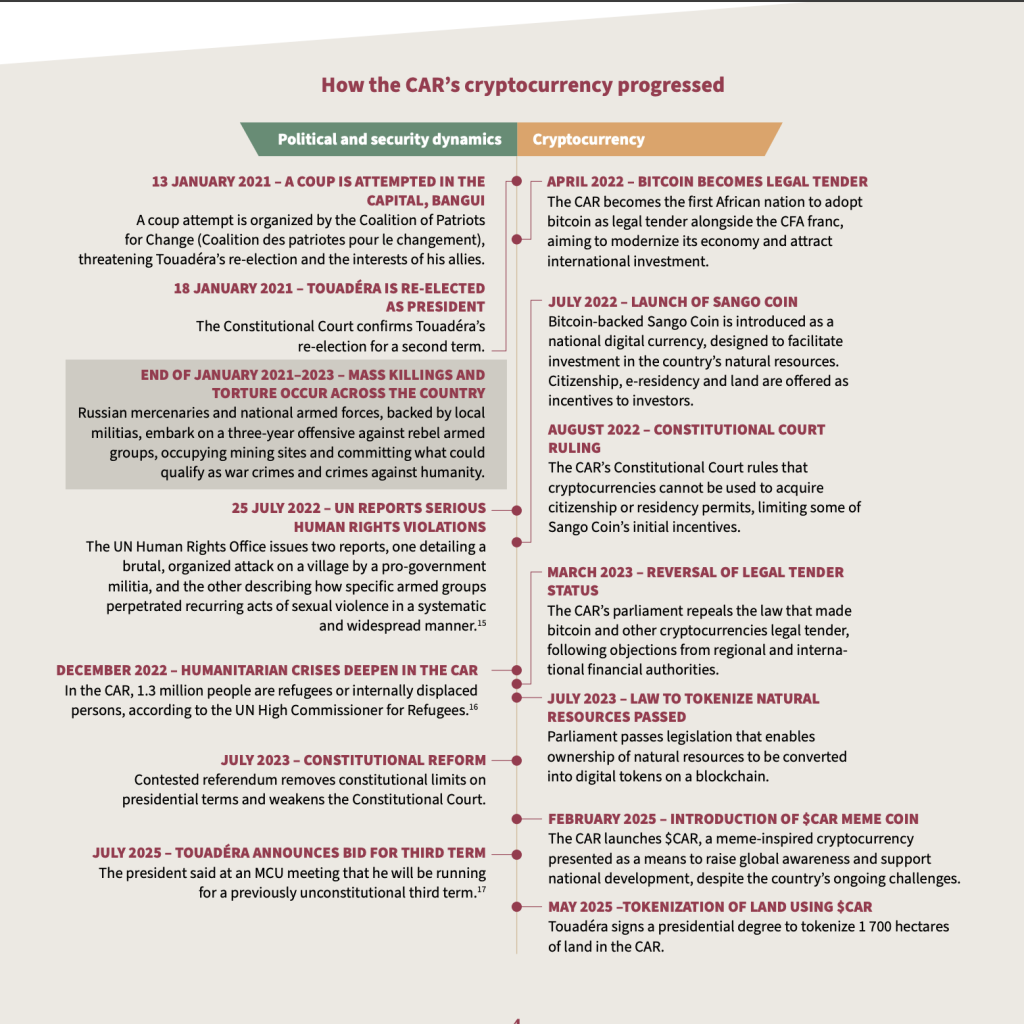
In April 2022, the Central African Republic enacted a legal framework that recognizes cryptocurrencies and designates Bitcoin as legal tender alongside the CFA franc. The move made CAR the first African nation and the second globally, after El Salvador, to adopt Bitcoin as a legal tender.
The initiative marked the first in a series of crypto-related policies championed by President Faustin-Archange Touadéra as a “path to prosperity” for the country.
The policy was introduced without consultation with domestic financial institutions or regional monetary authorities, prompting opposition from both local stakeholders and international bodies, including the United Nations Conference on Trade and Development (UNCTAD).
The UN body raised concerns over the legalization of Bitcoin as legal tender, particularly in developing countries like CAR, as it could facilitate illicit financial activity and economic instability.
The GI-TOC report concludes that the policy was intended to attract foreign investors, noting that the majority of CAR’s population lacks the infrastructure and resources required to engage in digital asset transactions.
The Launch of Sango Coin as a National Cryptocurrency
Less than three months into the legalization of Bitcoin and amidst growing domestic and international opposition, CAR began issuing Sango Coin on Bitcoin as its national cryptocurrency.
In July 2022, the CAR government launched Sango Coin with the goal of creating a new monetary system for the country that would include a digital national bank and a national bitcoin treasury.
The initiative began by offering tokens to foreigners in exchange for passports, e-residency, and land concessions. Foreign nationals could obtain citizenship for $60,000 worth of Sango Coin, provided the tokens were held for a minimum of five years. E-residency and land plots were offered in exchange for $6,000 and $10,000 in Sango Coin, with mandatory holding periods of three and ten years, respectively.
In August 2022, the constitutional court ruled that the use of cryptocurrency to purchase passports, e-residency, and plots of land was unconstitutional. Nevertheless, the government continued to support the project, holding that the decision did not call into question the previously enacted law that governs cryptocurrency.
In March 2023, the CAR parliament amended the crypto framework, formally revoking Bitcoin’s status as legal tender following pressure from the Economic and Monetary Community of Central Africa (CEMAC), the International Monetary Fund, and the World Bank.
Only around 10% of the Sango Coin supply was ultimately purchased. The initiative failed to gain traction and was effectively abandoned in April 2025, when the official website was taken offline.
New Law on Tokenization of Land and Natural Resources
Still in the pursuit of what the CAR government described as “economic prosperity and modernization” through cryptocurrency, CAR’s parliament passed another law on September 2 to complement the existing crypto framework, despite the Constitutional Court’s earlier ruling and opposition from regional and international institutions.
The new law sought to digitize and tokenize land and other national resources, including minerals and petroleum, while explicitly authorizing the use of Sango Coin for investment.
Once again, the government’s move drew criticism from oversight bodies, including the Action Group Against Money Laundering in Central Africa (Groupe d’action contre le blanchiment d’argent en Afrique Centrale, GABAC), which cautioned against the inherent risks associated with virtual assets. GABAC emphasized that no prior risk assessment had been conducted to evaluate its potential vulnerabilities.
The $CAR Meme Coin
Following the poor performance of Sango Coin, President Touadéra announced on X yet another crypto venture: the launch of the $CAR meme coin on the Solana blockchain in February 2025.
In the post, Touadéra described the token as “an experiment designed to show how something as simple as a meme can unite people, support national development, and put the Central African Republic on the world stage in a unique way.”
Unlike Sango Coin, which had a one-year lock-up period, the $CAR meme coin was immediately tradable upon launch. It rallied up to a market capitalization of over $900 million during the weekend of its launch before losing 75% of its value in the coming days.
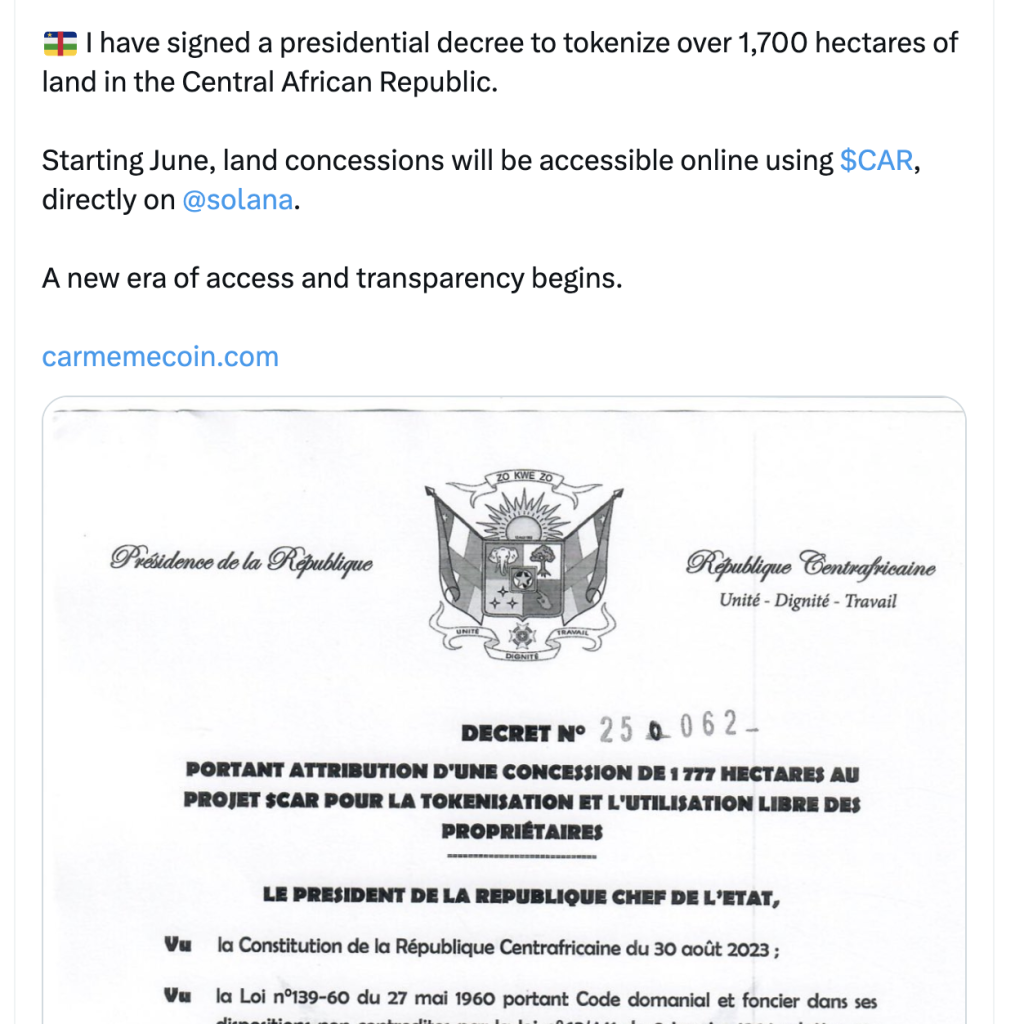
In May 2025, the president announced on X that he had signed a presidential decree authorizing the tokenization of 1,700 acres of land, payable directly in $CAR on the Solana blockchain. Following the announcement, the token’s price rose as more than 122 plots were reportedly sold over the next five months at a fixed price of $314 per plot.
Enabling Crypto Crime and Elite Enrichment
According to the GI-TOC report, the CAR government’s rapid and persistent embrace of cryptocurrency, purportedly to create a new monetary system, appears to be “an attempt to bypass financial regulatory constraints,” giving room for organized crypto-crime networks to exploit the country’s financial system and natural resources.
While traditional banking infrastructure is not totally immune to facilitating illicit financial transactions, the pseudonymous and borderless nature of virtual assets makes them an increasingly attractive option for criminals.
In the current quarter, INTERPOL has conducted two large crackdowns on cybercrime in Africa, including the seizure of over $260 million lost by victims of crypto investment scams linked to organized cybercriminal networks operating across Africa, as well as Operation Serengeti 2.0, which recovered $97.4 million in Africa from crypto scams and cybercrimes.