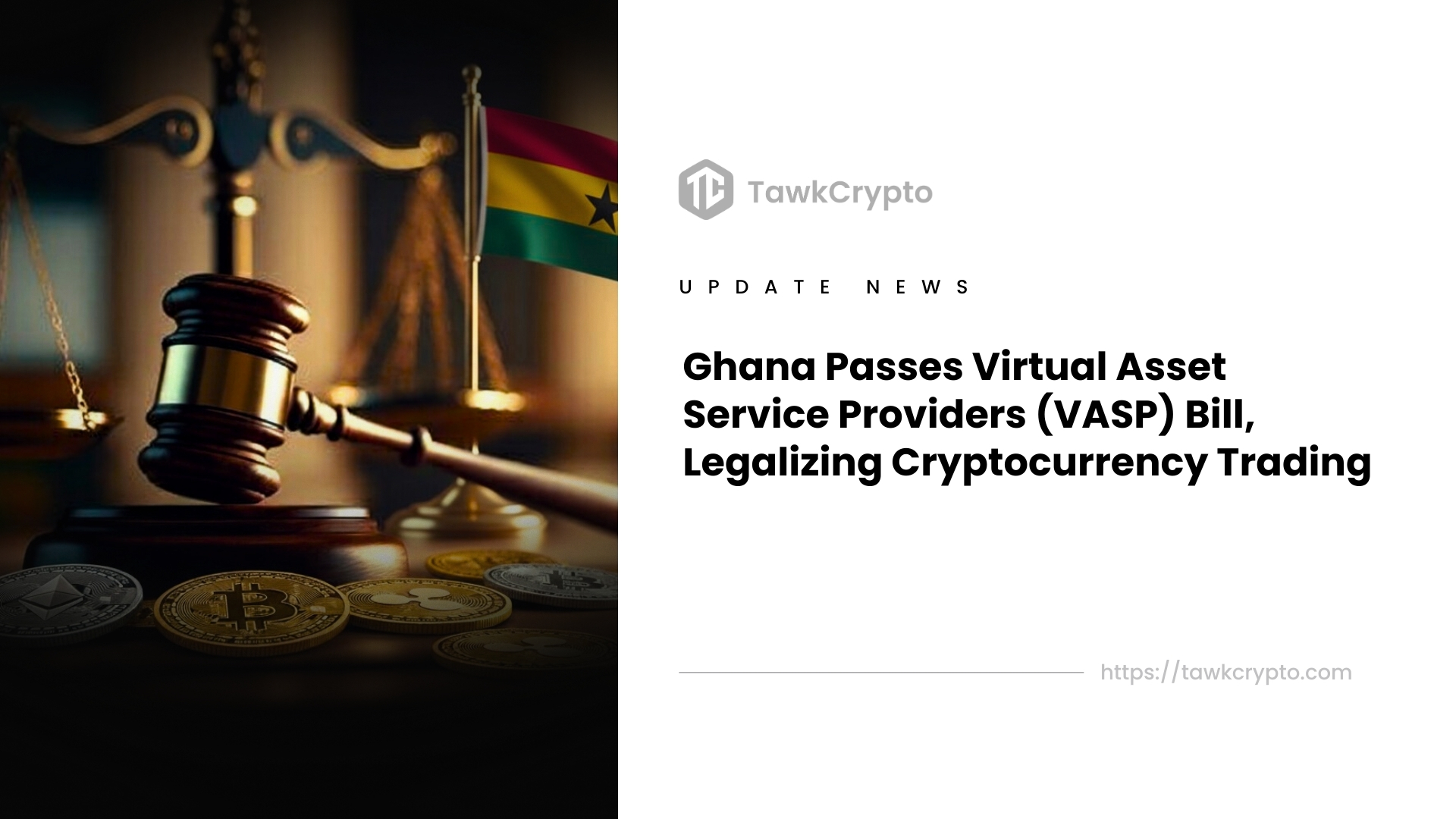
The Ghanaian Parliament has passed the long-anticipated Virtual Asset Service Providers (VASP) Bill into law, establishing its first comprehensive legal and regulatory framework for digital assets in Ghana.
The decision was confirmed by Johnson Asiama, Governor of the Bank of Ghana, during the Central Bank’s annual Thanksgiving service.
Speaking at the event, Johnson noted that the newly enacted law will ensure that digital asset activity “is brought within clear, accountable, and well-governed boundaries.”
The Bank of Ghana had earlier confirmed the completion of the VASP Bill and disclosed that the act was expected to be passed and operational by December during discussions with the International Monetary Fund (IMF) in October.
At the Thanksgiving service, the governor also highlighted that the enactment of the law and other recent efforts towards modernization of the country’s financial infrastructure are part of a broader plan to position Ghana to compete efficiently within the African Continental Free Trade Area (AfCFTA) region.

Legalization of Cryptocurrency in Ghana
The new law legalizes cryptocurrency trading for individuals and institutions and clarifies the regulatory status of digital assets in Ghana.
In 2019, the Ghana Securities and Exchange Commission (SEC), in coordination with the Bank of Ghana, issued a public notice stating that cryptocurrencies were neither recognized as legal tender nor as an approved currency.
The Bank of Ghana has now shifted to a neutral and progressive approach, officially bringing virtual assets under regulatory oversight.
According to Asiama, with the new law in place, cryptocurrency trading is now a legally recognized activity, and participants operating within the framework are protected.
The law does not confer legal tender status on cryptocurrency or replace the Ghanaian cedi with cryptocurrency. Rather, it formally recognizes cryptocurrencies and virtual assets in general as an acceptable means of transactions and settlements under regulated conditions.
From Blueprint to Action
Over the past three years, the Bank of Ghana has released multiple draft guidelines, policy documents, and the VASP Bill itself as part of a broader effort to establish comprehensive regulation for virtual asset activity in the country.
The most recent initiative was the publication of a policy document on virtual assets and service providers, which outlined eight key recommendations for developing a progressive regulatory framework for virtual assets.
Some of these key recommendations are now reflected in the newly enacted laws, including.
- Mandatory licensing for crypto service providers by the BoG and the SEC,
- Consumer protection through strict internal controls, audits, and demonstration of financial stability
- Compliance with Anti-Money Laundering (AML) and Counter-Terrorism Financing (CTF) requirements
A New Era for Digital Asset Ecosystem in Ghana
While Nigeria, Kenya, and South Africa currently lead in digital asset adoption in Africa, Ghana boasts at least 3 million citizens actively trading cryptocurrencies, with an estimated yearly transaction volume of $3 billion in 2024, making it a significant crypto market in Africa.
A comprehensive regulatory framework, such as the VASP Act, is expected to create a market that fosters innovation while striking a balance with adequate regulatory oversight to ensure sustainable growth of the digital asset ecosystem.
Even in more mature African crypto markets, such as Kenya and Nigeria, governments continue to pursue efforts towards a comprehensive regulatory framework for crypto and virtual assets. Regulatory clarity has proven essential for attracting investment while protecting consumers from risks, including fraud, market manipulation, and cyber threats.
Ghana has long anticipated the enactment of a virtual asset regulatory framework to efficiently harness the economic benefits of cryptocurrency adoption without undermining local monetary sovereignty or economic stability.
For Ghana, the passage of the VASP Act marks a new era, one in which cryptocurrencies are formally recognized within a regulated environment, with consumer protection taking priority and service providers required to act within clearly defined operational standards.