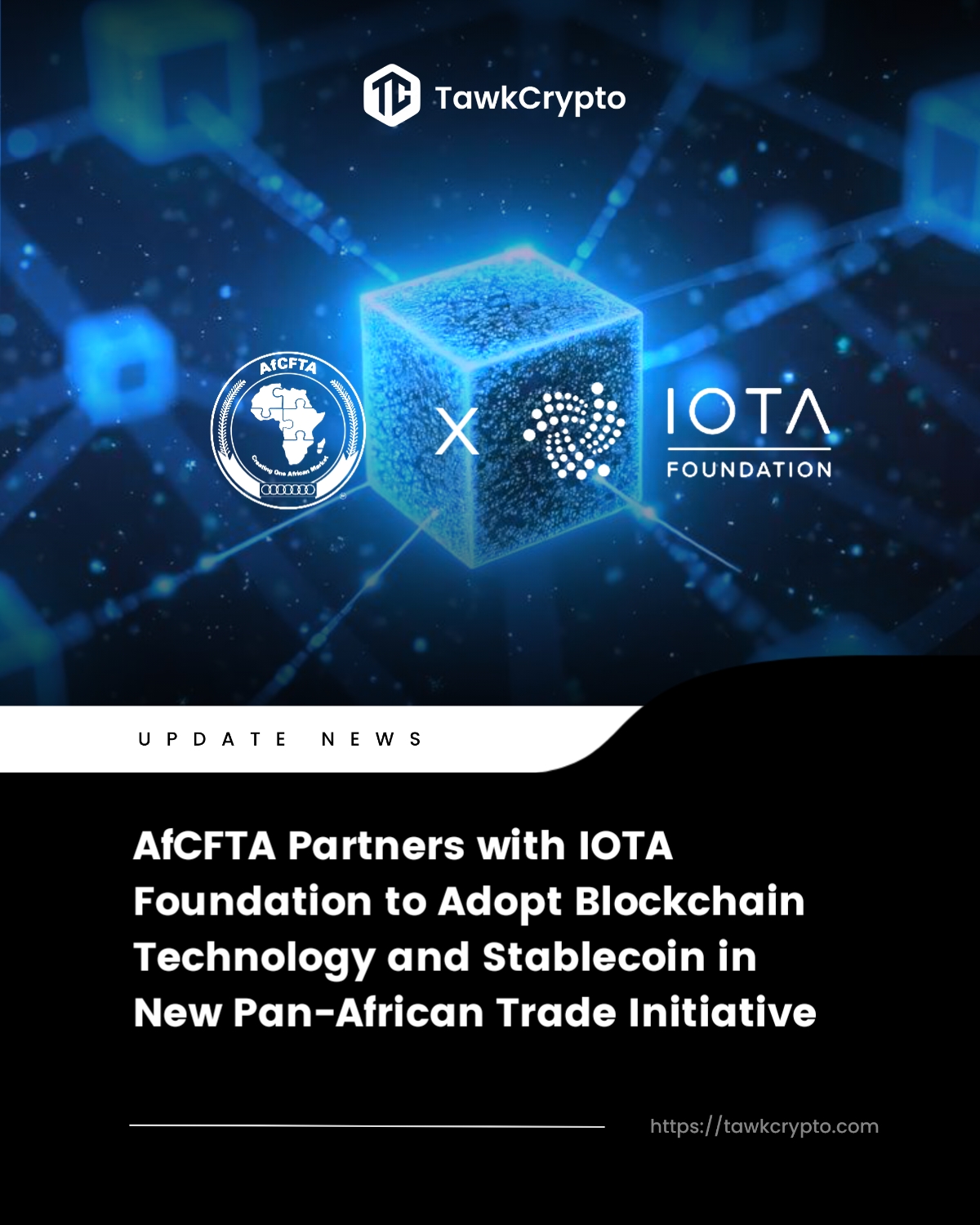
The African Continental Free Trade Area (AfCFTA) has partnered with the IOTA Foundation, the Tony Blair Institute, and the World Economic Forum (WEF) to launch a new digital trade initiative, the Africa Digital Access and Public Infrastructure for Trade (ADAPT).
The IOTA Foundation is a non-profit organization that provides organizations, projects, and governments with decentralized ledger infrastructure required to support digital, trustless applications.
The ADAPT initiative aims to modernise trade across Africa’s 55 member states with a projection of up to $70 billion in trade value and $23.6 billion in annual economic gains by 2035.
According to the announcement made on Monday, the initiative will deploy shared, open-source digital public infrastructure and establish stablecoin-settlement systems for member states.
ADAPT will begin with Kenya, Ghana, and a third country (yet to be confirmed) before expanding across the continent from 2026, with the goal of integrating all 55 AfCFTA nations by 2035.
How Blockchain Technology Addresses Africa’s Inefficient and Burdensome Trade Systems
Despite AfCFTA’s mandate to foster a unified African trade market, the region continues to trail behind global counterparts due to high transaction costs, manual documentation, fraud, and mismanagement.
During the initiative announcement, it was stated that African traders collectively pay an estimated $25 billion in annual transaction fees, while document fraud contributes to billions more in losses.
The operational analogue trading system has also exacerbated these challenges, as multiple parties and documents are required to execute a single trade. For instance, a single shipment may require 30 entities to exchange 240 paper documents. In Kenya, border agents previously needed to log into 13 different systems to verify a consignment.
The adoption of blockchain technology streamlines the entire trade process, eliminating multiple parties and providing tamper-proof document verification and transparent audit trails.
Kenya is already seeing measurable results from the pilot programme. Exporters are saving roughly $400 per month on printing and documentation, freight forwarders have cut manual paperwork by up to 60%, and border clearance times have fallen from six hours to about 30 minutes.
With full implementation expected in 2026, Kenya alone is projected to record about 100,000 transactions per day on IOTA’s distributed ledger.
The distributed ledger addresses the challenges of documentation and recording; the next phase, which is the primary target of the initiative, is the expansion into digital trade finance via stablecoins.
Stablecoin: Enabling Instant Pan-African Trade Settlement
Stablecoins are already widely used in African retail and institutional markets, especially in Nigeria, Kenya, and South Africa. However, ADAPT aims to scale stablecoin usage to the regional level, creating a unified settlement layer that bypasses traditional financial bottlenecks such as slow cross-border transfers, costly intermediaries, and limited interoperability.
The initiative targets freight transport, which is the backbone of international trade within and across Africa. Typically, it involves multiple currency conversions due to the numerous countries involved in a trade, leading to high transaction fees and slow processing times.
The integration of stablecoin, a standardised settlement medium, substantially eliminates these challenges, enabling low-cost and instant cross-border transactions.
Now that we’ve solved the data problem — digitising and authenticating trade documents — we can do the trade finance part,” IOTA Foundation founder Dominik Schiener told CoinDesk.
“We will also offer tokenisation of physical assets such as commodities and critical minerals, and cross-border payments using stablecoins like USDT for real-world payments.”
Stablecoins also improve financial inclusion and access, a gap that traditional finance has historically exacerbated through operational bureaucracy. With a smartphone and internet connection, anyone can access on-chain finances and send and receive payments.
We could help a miner in Rwanda get access to on-chain trade finance at 50% of the cost, getting paid almost instantly with low transaction fees using USDT,” Schiener told CoinDesk.
”This is how we move beyond the typical boom and bust cycles in crypto and anchor our industry with real assets, real adoption, and real value.”

The Regional Regulatory Harmonization Challenge
The introduction of the ADAPT initiative has transformative potential for the African economy. It would be considered timely, as many African countries are now exploring the adoption and regulation of stablecoins.
However, the absence of a harmonized regional regulatory framework remains one of the key challenges to the success of the initiative. Stablecoin regulatory efforts across the continent have been at a domestic level, with each country working towards comprehensive national virtual assets legislation.
This regulatory fragmentation could create legal frictions once ADAPT is fully operational in 2026, as traders will still be governed by domestic laws that may conflict with those of their counterparties.
The development of a unified regional virtual assets framework may become essential for the initiative’s long-term success.
ADAPT Initiative: A Step Closer Towards AfCFTA’s Vision
The goal of AfCFTA is a single continental market where everyone can gain access and participate without any form of monopoly.
The introduction of blockchain technology and stablecoin settlement eliminates financial and operational barriers, fostering access and inclusion into the trade market even for small and medium-sized businesses.
By digitising trade, streamlining payments, and leveraging open-source infrastructure, the ADAPT initiative levels the playing field for all market participants, moving the continent closer to its goal.
The collaboration between AfCFTA, the IOTA Foundation, and institutional partners such as the Tony Blair Institute signals Africa’s commitment to embracing modern approaches to long-standing trade challenges.