ByBit and DL Research have released the World Crypto Adoption Report 2025, analyzing crypto adoption across 79 countries using four core pillars: user penetration, transactional use, institutional readiness, and cultural penetration.
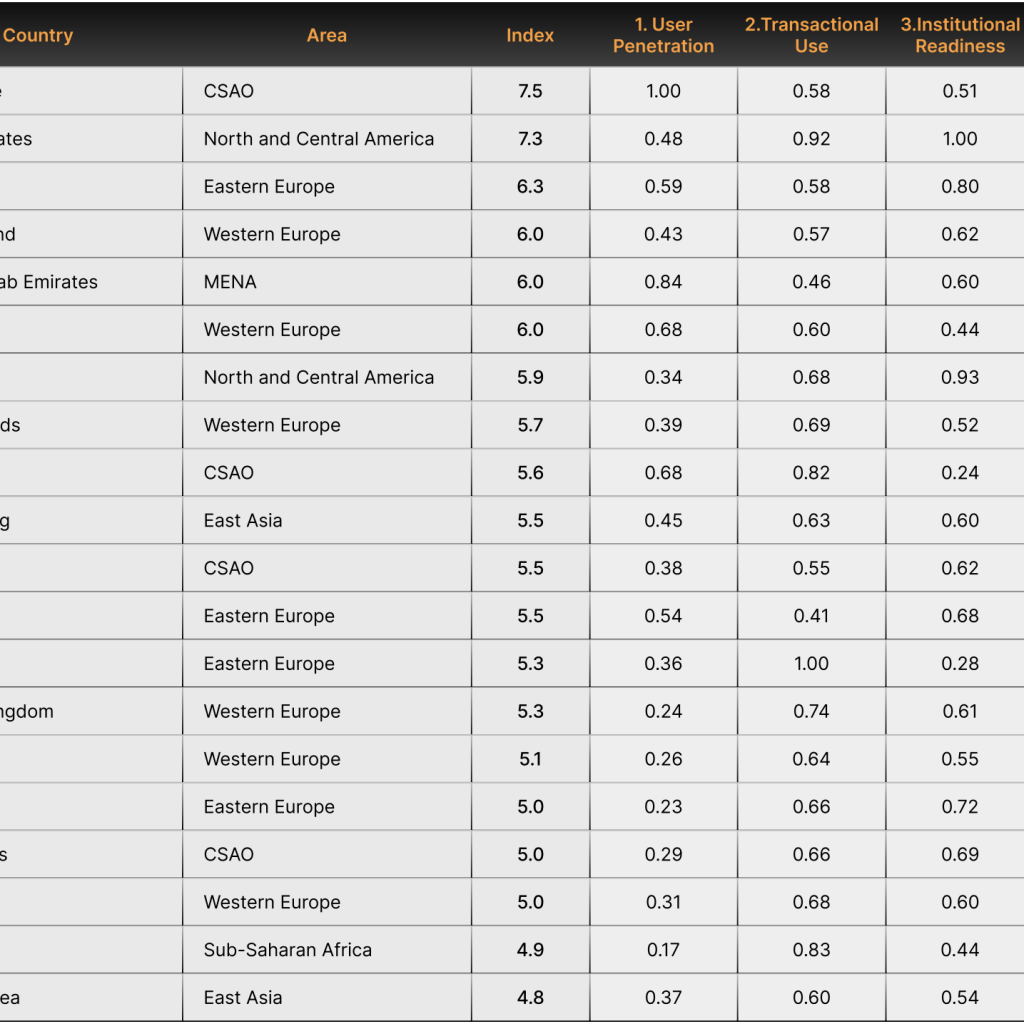
Singapore and the United States lead the global ranking, demonstrating strong balance across the four pillars. Each pillar is scored on a 0-1 scale, where 1 represents strong global performance and 0 represents the opposite. Singapore scored 1 in user penetration, while the United States scored 1 in institutional readiness.
However, Nigeria recorded a 0.17 in user penetration, the lowest in the report, while scoring 0.83 in transaction use, one of the highest globally. This position puts Nigeria just behind the United States, which scored the highest at 0.88.
These figures reveal that Nigeria’s crypto market is characterized by exceptionally high transaction volumes driven by remittances and peer-to-peer (P2P) trading but limited penetration across the broader population. Crypto usage remains concentrated among a relatively small segment of users, despite the high-value transactions.
Necessity-Driven Adoption by Low-Income Countries
According to the report, growing cryptocurrency adoption in low-income countries such as Nigeria and other top performers like Vietnam and the Philippines is largely driven by necessity.
For these countries, cryptocurrency serves as an effective substitute against high inflation rates, costly remittance costs, and gaps in access to financial infrastructures.
This is evident in Nigeria’s strong reliance on and adoption of stablecoins. Recent reports, such as the Chainalysis report, rank Nigeria as the second-highest adopter of stablecoins. The cryptocurrency market, particularly stablecoins in Nigeria, has experienced unprecedented growth in the last few years as citizens seek alternatives to savings and settlement options.
According to the report, these rankings demonstrate the significance of high grassroots demand in the adoption of alternative and inclusive financial systems such as cryptocurrency.
Sub-Saharan Africa’s Position in Crypto Global Adoption
In the report’s regional overview, Sub-Saharan Africa ranks sixth out of seven global regions. Notable country mentions include South Africa, Kenya, and Nigeria.
It identifies South Africa as one of Africa’s most mature crypto markets, balancing adoption through high crypto ownership, where it ranks 11th globally, steady DeFi participation, an active retail community, and a relatively clear crypto oversight framework. South Africa’s overall user penetration is relatively modest, ahead of most of its African contemporaries, as it ranks 36th globally.
Kenya stands out regionally and globally in transactional use, where it ranks 5th globally in stablecoin adoption. Its strength lies in its exceptionally high P2P activity, particularly through mobile money systems like M-Pesa.
User penetration, on the other hand, remains modest, as it ranks 60th globally. The regulatory outlook in Kenya is also becoming clearer, following the recently enacted Virtual Assets Service Provider (VASP) Act.
Nigeria remains sub-Saharan Africa’s leading cryptocurrency market, ranking 3rd in transaction use, which is supported by exceptionally high transactional volume, active DeFi activity, and strong cultural penetration. Nigeria ranks 19th in regulatory clarity, reflecting the shift in the country’s regulatory stance from outright restrictions to active engagement between regulators and industry stakeholders.
Although Nigeria’s youth population is among the most active crypto user bases globally, overall user penetration remains limited and uneven, placing the country 40th worldwide. Crypto ownership, however, ranks relatively high at 20th, reinforcing the finding that transaction volumes are concentrated within specific segments of the population. Some additional challenges include modest integration with existing TradFi infrastructure and infrastructure gaps in merchant adoption.
Although these three countries lead crypto adoption in Africa, other African countries are rapidly exploring crypto innovation and comprehensive oversight. These countries include Ethiopia, Ghana, Uganda, Senegal, Rwanda, and Zimbabwe, which have all ranked in the top 100 of global crypto adoption.
Looking Ahead: The Future of Crypto in Sub-Saharan Africa
Though not adequately represented, the sub-Saharan African region has established a distinct position within the global cryptocurrency community.
The World Crypto report reveals that practical, necessity-driven use cases remain the primary adoption catalyst across the region. Although this has elevated countries such as Nigeria and Kenya in transactional metrics, they continue to lag in user penetration and institutional readiness. These findings underscore both the importance of cryptocurrency as a tool for financial inclusion and the need for broader structural development in the region.
For the region to effectively compete with other regions and ensure more inclusive participation, African innovators and policymakers must explore crypto use cases beyond retail and P2P transactions.