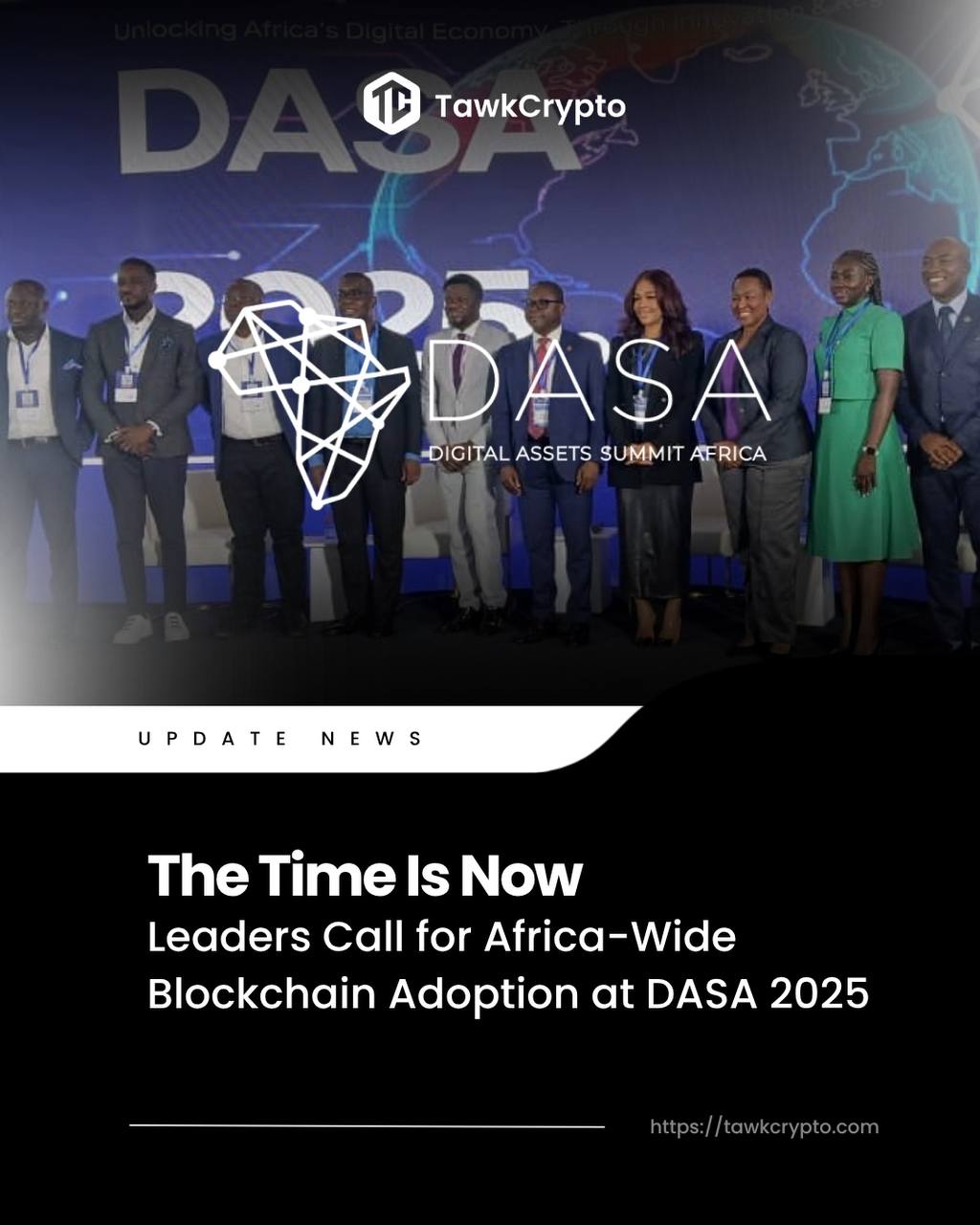
Accra played host to a landmark gathering this week as digital finance stakeholders from across Africa convened to map out the continent’s strategic position in the rapidly evolving global cryptocurrency and blockchain landscape.
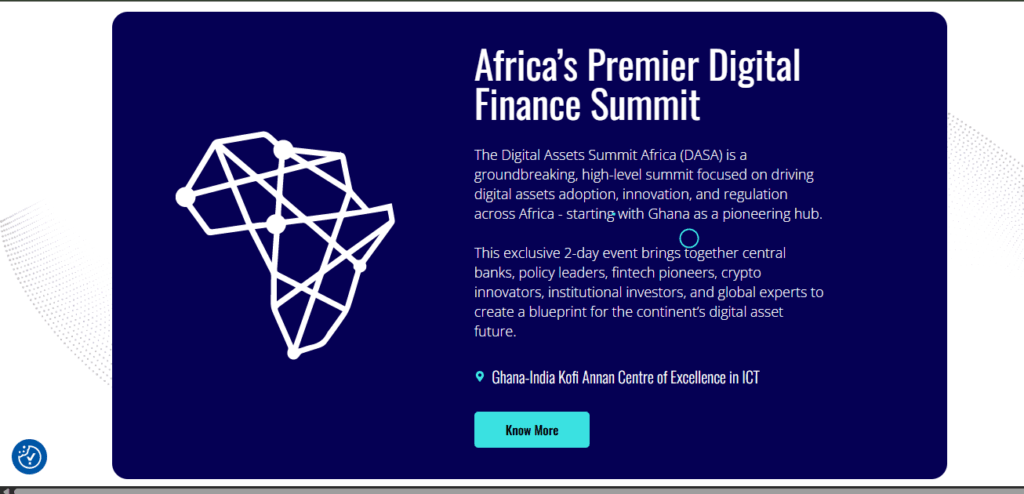
The Digital Assets Summit Africa (DASA) 2025 concluded on Monday following two intensive days of dialogue, debate, and discovery at Ghana’s Kofi Annan Centre of Excellence in ICT. What emerged was a clear consensus: Africa isn’t just participating in the digital assets revolution, it’s positioning itself to lead it.
Where Innovation Meets Regulation
Running from September 29-30, the summit assembled an impressive cross-section of Africa’s financial ecosystem. Policymakers sat alongside blockchain developers, central bankers engaged with fintech founders, and traditional financial institutions explored partnerships with cryptocurrency innovators. The overarching theme, “Unlocking Africa’s Digital Economy Through Innovation and Regulation,” wasn’t merely aspirational, it reflected genuine urgency.
Professor Tonya M. Evans, who serves on the board at Digital Currency Group, delivered what many attendees described as the summit’s most compelling call to action. Rather than viewing digital assets through the lens of disruption, she urged Africa’s established banks to recognize the opportunity sitting before them.
“This isn’t about replacing traditional banking,” Evans emphasized during her keynote. “It’s about serving customers better through partnership and experimentation with blockchain technology.”
Her message resonated particularly strongly with financial institutions grappling with the reality of changing customer expectations and increasingly sophisticated fintech competitors.
Solving African Problems with African Solutions
Evans didn’t stop at encouraging collaboration. She challenged Ghana specifically, and Africa broadly, to think beyond merely adopting technologies developed elsewhere. The real value proposition, she argued, lies in building digital asset solutions tailored to African challenges.
Her vision painted a compelling picture: smart contracts revolutionizing agricultural supply chains, bringing unprecedented transparency to farm-to-market operations. Cross-border payments that currently take days reduced to mere minutes. Programmable cash transfers ensuring aid reaches intended recipients without intermediaries. Continental trade settlements executed with efficiency that current systems simply cannot match.
These aren’t distant possibilities. According to Evans, they’re achievable goals if African entrepreneurs focus on solving real problems rather than chasing trends that originated in different economic contexts.
The Data-Driven Approach
Professor Samuel Kobina Annim, who directs the African Centre for Statistics, brought an often-overlooked perspective to the conversation: the critical role of data in shaping effective policy. His years as Ghana’s Government Statistician taught him that evidence must precede regulation.
“We shouldn’t only use data to assess government performance after the fact,” Annim explained to summit attendees. “Statistics need to inform policy design from the beginning, helping us understand the tradeoffs inherent in any decision.”
His point struck at a fundamental challenge facing African regulators, crafting rules for technologies that evolve faster than traditional legislative processes can accommodate.
Evans reinforced this theme, urging policymakers to embrace evidence-based regulation rather than reactive rule-making driven by fear of the unknown. She encouraged African nations to study regulatory approaches that have succeeded internationally, adapting proven frameworks rather than reinventing regulatory wheels.
Trust, Demographics, and the Banking Evolution
Robert Dzato, who leads the Chartered Institute of Bankers Ghana, offered candid observations about Africa’s shifting financial landscape. The demographics tell an undeniable story: young Africans increasingly place their trust in digital platforms rather than traditional banking institutions.
“The financial sector fundamentally operates on trust,” Dzato noted. “That trust emerges from character, competence, proper conduct through regulation, and real consequences for those who defraud investors.”
His framework applies equally whether that trust exists between a customer and a brick-and-mortar bank or between a user and a decentralized finance protocol.
Dzato’s message carried particular weight given his institutional position, here was a representative of traditional banking acknowledging that the sector must evolve or risk losing relevance with Africa’s digital-native generation.
Stablecoins and the Inflation Challenge
Mimi Kufuor, CEO of Koinkoin Ghana Limited, brought the conversation back to practical realities facing everyday Africans. In a continent where currency volatility and inflation regularly erode purchasing power, stablecoins represent more than technological novelty, they’re potential tools for financial stability.
Kufuor advocated for Africa to pursue interoperability in its digital asset infrastructure, enabling seamless cross-border trade within the continent. She pointed to Africa’s fluctuating political and economic climate as precisely why stablecoins matter: they can provide a hedge against local currency instability without requiring citizens to navigate complex foreign exchange markets.
However, she was equally clear about risks. Bitcoin’s price volatility makes it suitable primarily as a store of value rather than a medium for everyday transactions. While institutions might weather that volatility, average citizens conducting daily business need stability. That’s where properly designed stablecoins enter the picture, offering the benefits of digital assets without exposing users to cryptocurrency’s notorious price swings.
Kufuor’s advice to prospective investors was pragmatic: understand market dynamics, grasp tax implications, and approach digital assets with clear-eyed awareness of both opportunities and risks.
The Path Forward
Summit organizers articulated three fundamental objectives that now serve as guideposts for Africa’s digital asset journey:
First, developing inclusive regulatory frameworks that enable innovation while protecting consumers. This requires moving beyond simply copying regulations written for different contexts, instead crafting rules that acknowledge African realities, from infrastructure limitations to unique use cases that don’t exist in developed economies.
Second, prioritizing financial inclusion for the millions of Africans currently underserved or entirely excluded from traditional banking. Digital assets offer potential pathways to financial services for populations that existing banks find unprofitable to serve through conventional means.
Third, exploring how tokenization and the convergence of artificial intelligence with blockchain might unlock new forms of economic empowerment. This means looking beyond cryptocurrencies to consider how blockchain’s core capabilities, transparency, programmability, and reduced intermediation, can be applied across various economic activities.
A Unified African Voice
Perhaps DASA 2025’s most significant outcome wasn’t any single policy recommendation or technological proposal. Instead, it was the gathering itself, proof that Africa can convene stakeholders across countries, sectors, and specializations to articulate a coherent continental vision.
As regulatory clarity emerges in markets like Nigeria, Kenya, and South Africa, the summit’s emphasis on pan-African collaboration takes on practical importance. Fragmented regulatory approaches risk creating barriers within Africa even as digital assets promise to reduce barriers globally. Coordination doesn’t require uniformity, but it does benefit from regular dialogue and shared learning.
The recurring theme throughout both days was balance: innovation paired with appropriate oversight, experimentation enabled alongside consumer protection, ambition tempered with pragmatism. These aren’t contradictions but complementary imperatives for any emerging technology in societies where stakes are high and safety nets are thin.
As attendees departed Accra, the consensus was clear. Africa’s digital asset journey has moved beyond questions of whether to engage with blockchain and cryptocurrencies. The conversation has shifted to how, how to build, how to regulate, how to ensure benefits spread broadly rather than concentrating narrowly, and how to position Africa not as a technology consumer but as an innovation contributor on the global stage.